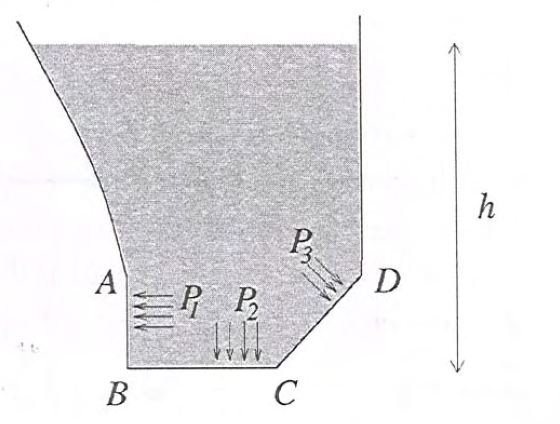
A tall tank filled with water has an irregular shape as shown. The wall CD makes an angle of 45∘ with the horizontal; the wall AB is normal to the base BC. The lengths AB and CD are much smaller than the height h of water (figure not to scale).
Let P1, P2 and P3 be the pressures exerted by the water on the wall AB, base BC and the wall CD respectively. Density of water is ρ and g is acceleration due to gravity. Then, approximately
Answer and worked solutionTry it first, then open this to check your working.
Official answerA
Worked solution
Hydrostatic pressure is isotropic.
At a point at depth d below the free surface the water's pressure is p=p0+ρgd, and it is the same in every direction: on a vertical wall, on a horizontal base, or on a wall tilted at 45∘. A tilt changes the direction of the force (always normal to the surface) and the area, but not the pressure.
All three walls sit at essentially the same depth.AB and CD are much shorter than h, and B, C lie on the base, so every point of AB, BC and CD is at depth ≈h. Hence P1≈P2≈P3≈ρgh.
The 1/2 in options (B) and (C) would be right for a force component, not for the pressure; and the pressure on a vertical wall is certainly not zero.
(A)
Practise this topic
Every past question tagged to the same part of the syllabus, with solutions.