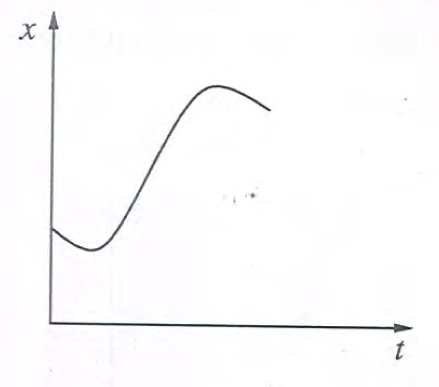
The accompanying graph of position versus time represents the motion of a particle. If and are both positive constants, the expression that best describes the acceleration of the particle is
From KVPY 2013 · Stream SA
The accompanying graph of position versus time represents the motion of a particle. If and are both positive constants, the expression that best describes the acceleration of the particle is
Worked solution
Read the curvature of , not its height.
Acceleration is the second derivative, so its sign is the sign of the curvature:
So starts positive and decreases steadily through zero: at the inflexion point, where the curve is steepest: to negative values. A straight line of negative slope with a positive intercept is
Option (A) is negative throughout, (B) starts negative, (C) stays positive.
(D)
Every past question tagged to the same part of the syllabus, with solutions.
Timed, in the real format, and marked the moment you submit.