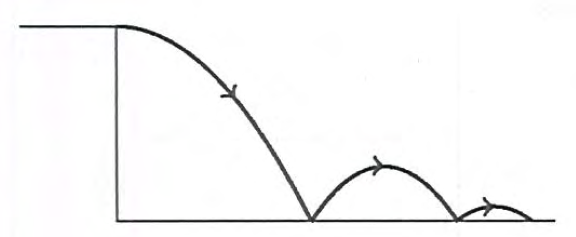
Between bounces. Only gravity acts, so vy changes linearly with slope −g. The ball is launched horizontally, so vy(0)=0 and vy runs down into negative values (downward) along a straight line.
At a bounce. The contact is almost instantaneous, so vy jumps: it arrives at −u and leaves at +eu with e<1. The jump is upward (negative to positive) and each jump is smaller than the one before, because u itself shrinks.
Between the next bounces. The straight line again has slope −g: the same slope every time, since g does not change: crossing zero at the top of each arc.
So the graph is a sawtooth of parallel downward-sloping segments, each beginning at a positive value smaller than the last and ending at a negative value, with upward jumps at the bounces.
Option (A) has the first segment rising, which is wrong. Option (C) draws later segments with a smaller slope, but the slope is always −g. Option (D) has no jump at all, so the speed reverses smoothly, which a bounce does not do.
(B)