Skip to content
dronacharya.ai
← JEE Main 2026 · 5 Apr · Shift 1
ChemistrySingle correct+4 / -1Question 66 of 75

JEE Main 2026 · 5 Apr · Shift 1, Chemistry question 66

Benzyl isocyanide can be obtained from

A. benzyl bromide + AgCN

B. benzylamine + CHClX3\ce{CHCl3}, aq NaOH

C. bromobenzene + AgCN

D. aniline + CHClX3\ce{CHCl3}, aq NaOH

E. (2-bromoethyl)benzene + KCN

Choose the correct answer from the options given below:
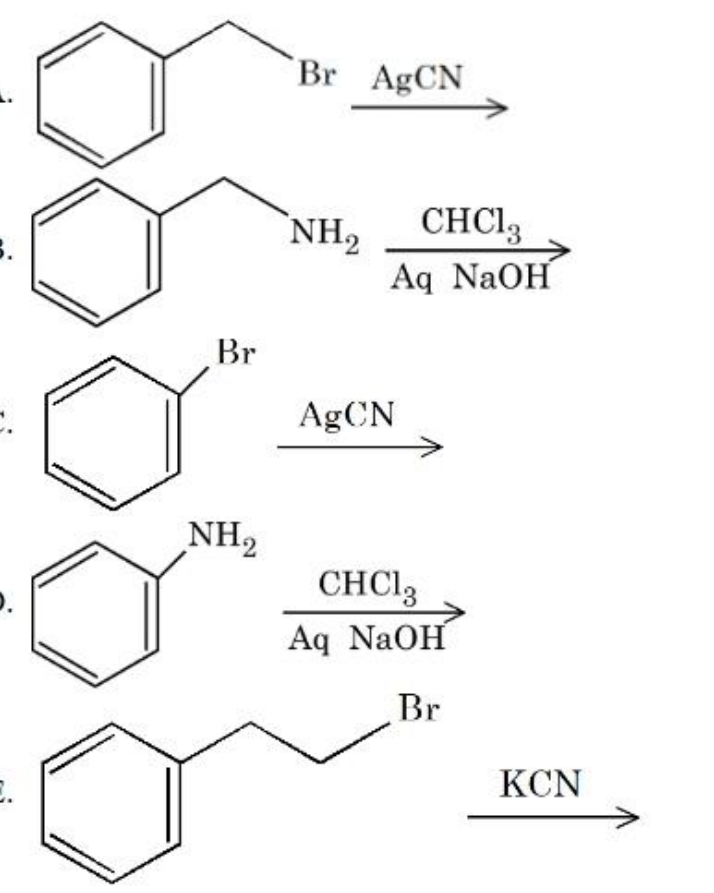
A: C₆H₅CH₂Br with AgCN; B: C₆H₅CH₂NH₂ with CHCl₃/aq NaOH; C: C₆H₅Br with AgCN; D: C₆H₅NH₂ with CHCl₃/aq NaOH; E: C₆H₅CH₂CH₂Br with KCN.
Choose one option
Answer and worked solution

Official answer: A

Each route.

  • A: CX6HX5CHX2Br\ce{C6H5CH2Br} + AgCN. AgCN is covalent, so nitrogen attacks and gives CX6HX5CHX2NC\ce{C6H5CH2NC}. Yes.
  • B: The carbylamine reaction of benzylamine gives CX6HX5CHX2NC\ce{C6H5CH2NC}. Yes.
  • C: Bromobenzene does not undergo nucleophilic substitution under these conditions. No.
  • D: The carbylamine reaction of aniline gives phenyl isocyanide. No.
  • E: KCN gives the nitrile CX6HX5CHX2CHX2CN\ce{C6H5CH2CH2CN}. No.

Correct: A and B.

(A)