Skip to content
dronacharya.ai
← JEE Advanced 2025 · Paper 1
PhysicsList match+4 / -1Question 31 of 48

JEE Advanced 2025 · Paper 1, Physics question 15

A circuit with an electrical load having impedance ZZ is connected with an AC source as shown in the diagram. The source voltage varies in time as V(t)=300sin⁡(400t)V(t) = 300\sin(400t) V, where tt is time in s. List-I shows various options for the load. The possible currents i(t)i(t) in the circuit as a function of time are given in List-II.

Choose the option that describes the correct match between the entries in List-I to those in List-II.
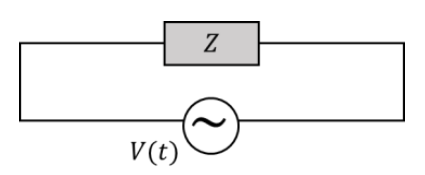
A load of impedance Z connected across an AC source V(t) in a single loop.

List-I

  • P
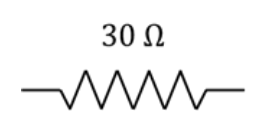
    A 30 Ω resistor alone.
  • Q
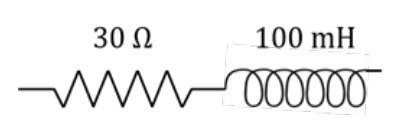
    A 30 Ω resistor in series with a 100 mH inductor.
  • R
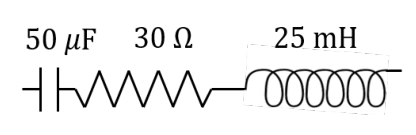
    A 50 μF capacitor, a 30 Ω resistor and a 25 mH inductor in series.
  • S
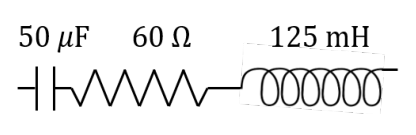
    A 50 μF capacitor, a 60 Ω resistor and a 125 mH inductor in series.

List-II

  • 1
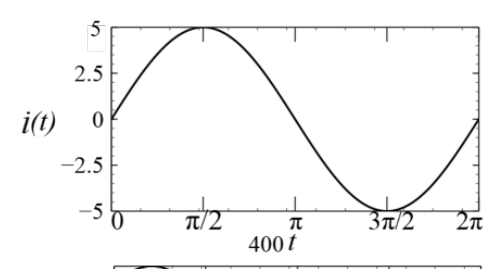
    Graph of i(t) against 400t from 0 to 2π (ticks at π/2, π, 3π/2, 2π): a sine curve of amplitude 5 starting at 0, peaking at +5 at π/2 and reaching −5 at 3π/2 (in phase with V).
  • 2
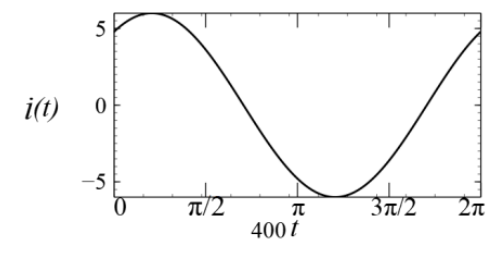
    Graph of i(t) against 400t from 0 to 2π (ticks at π/2, π, 3π/2, 2π): a sinusoid of amplitude about 6 starting near +5 at t = 0, peaking shortly after t = 0 (current leads the voltage by about 53°).
  • 3
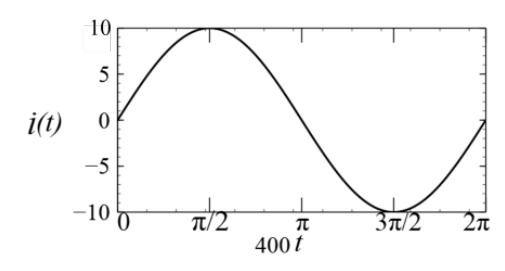
    Graph of i(t) against 400t from 0 to 2π (ticks at π/2, π, 3π/2, 2π): a sine curve of amplitude 10 starting at 0, peaking at +10 at π/2 (in phase with V).
  • 4
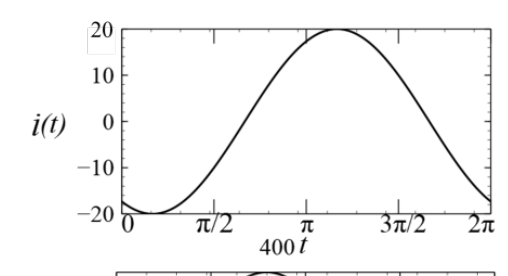
    Graph of i(t) against 400t from 0 to 2π (ticks at π/2, π, 3π/2, 2π): a sinusoid of amplitude 20 starting near −18, reaching −20 shortly after t = 0 and +20 shortly after π.
  • 5
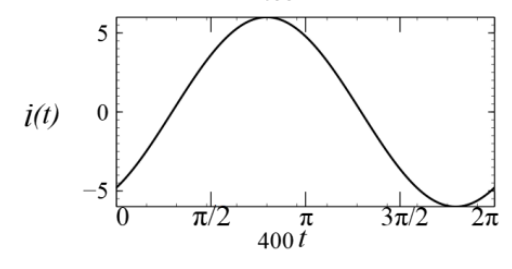
    Graph of i(t) against 400t from 0 to 2π (ticks at π/2, π, 3π/2, 2π): a sinusoid of amplitude about 6 starting near −5 at t = 0, crossing zero upwards before π/2 and peaking at about 0.8π (current lags the voltage by about 53°).
Choose one option
Answer and worked solution

Official answer: A

At ω=400\omega=400 s−1^{-1}:

  • XL=ωLX_L=\omega L: 100 mH gives 40 Ω, 25 mH gives 10 Ω, 125 mH gives 50 Ω.

  • XC=1ωCX_C=\frac1{\omega C}: 50 μF gives 50 Ω.

  • (P) 30 Ω alone: i=10sin⁡400ti=10\sin400t, in phase, amplitude 10 → (3).

  • (Q) Z=302+402=50Z=\sqrt{30^2+40^2}=50: amplitude 6, lagging by 53∘53^\circ. The current starts negative → (5).

  • (R) X=10−50=−40X=10-50=-40, so Z=50Z=50: amplitude 6, leading by 53∘53^\circ. The current starts near its peak → (2).

  • (S) XL=XCX_L=X_C (resonance), Z=60Z=60: amplitude 5, in phase → (1).

The match is P→3, Q→5, R→2, S→1, which is option (A).