Skip to content
dronacharya.ai
← JEE Advanced 2025 · Paper 1
PhysicsList match+4 / -1Question 30 of 48

JEE Advanced 2025 · Paper 1, Physics question 14

List-I shows four configurations, each consisting of a pair of ideal electric dipoles. Each dipole has a dipole moment of magnitude pp, oriented as marked by arrows in the figures. In all the configurations the dipoles are fixed such that they are at a distance 2r2r apart along the xx direction. The midpoint of the line joining the two dipoles is XX. The possible resultant electric fields E⃗\vec E at XX are given in List-II.

Choose the option that describes the correct match between the entries in List-I to those in List-II.
List-I

  • P
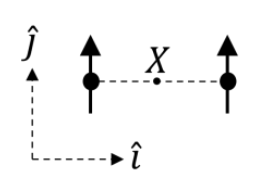
    Two point dipoles a distance 2r apart on a horizontal line along x, with X the midpoint (axes: î to the right, ĵ up). Both dipoles point up (+ĵ).
  • Q
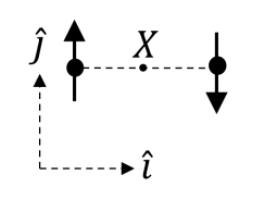
    Two point dipoles a distance 2r apart on a horizontal line along x, with X the midpoint (axes: î to the right, ĵ up). The left dipole points up (+ĵ), the right dipole points down (−ĵ).
  • R
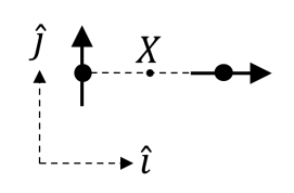
    Two point dipoles a distance 2r apart on a horizontal line along x, with X the midpoint (axes: î to the right, ĵ up). The left dipole points up (+ĵ), the right dipole points right (+î), along the line joining them.
  • S
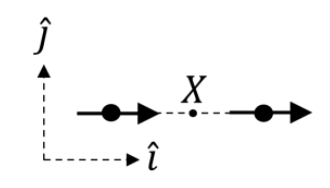
    Two point dipoles a distance 2r apart on a horizontal line along x, with X the midpoint (axes: î to the right, ĵ up). Both dipoles point right (+î), along the line joining them.

List-II

  • 1
    E⃗=0\vec E = 0
  • 2
    E⃗=−p2πϵ0r3j^\vec E = -\dfrac{p}{2\pi\epsilon_0r^3}\hat j
  • 3
    E⃗=−p4πϵ0r3(i^−j^)\vec E = -\dfrac{p}{4\pi\epsilon_0r^3}(\hat i - \hat j)
  • 4
    E⃗=p4πϵ0r3(2i^−j^)\vec E = \dfrac{p}{4\pi\epsilon_0r^3}(2\hat i - \hat j)
  • 5
    E⃗=pπϵ0r3i^\vec E = \dfrac{p}{\pi\epsilon_0r^3}\hat i
Choose one option
Answer and worked solution

Official answer: C

Let k=14πϵ0k=\frac1{4\pi\epsilon_0}. At distance rr from a dipole:

  • on its axis, E⃗=2kp⃗r3\vec E=\frac{2k\vec p}{r^3};
  • on its equatorial line, E⃗=−kp⃗r3\vec E=-\frac{k\vec p}{r^3}.

X is on the line joining the dipoles, a distance rr from each.

  • (P) Both point +j^+\hat j, so X is on both equatorial lines: E⃗=−2kpr3j^=−p2πϵ0r3j^\vec E=-\frac{2kp}{r^3}\hat j=-\frac{p}{2\pi\epsilon_0r^3}\hat j → (2).
  • (Q) Equal and opposite equatorial fields cancel: E⃗=0\vec E=0 → (1).
  • (R) −kpr3j^-\frac{kp}{r^3}\hat j (equatorial) plus 2kpr3i^\frac{2kp}{r^3}\hat i (axial): p4πϵ0r3(2i^−j^)\frac{p}{4\pi\epsilon_0r^3}(2\hat i-\hat j) → (4).
  • (S) Two axial fields: 4kpr3i^=pπϵ0r3i^\frac{4kp}{r^3}\hat i=\frac{p}{\pi\epsilon_0r^3}\hat i → (5).

The match is P→2, Q→1, R→4, S→5, which is option (C).