Skip to content
dronacharya.ai
← JEE Advanced 2023 · Paper 2
ChemistryMultiple correct+4 / -2Question 41 of 51

JEE Advanced 2023 · Paper 2, Chemistry question 7

In the following reactions, P, Q, R, and S are the major products.

The correct statement(s) about P, Q, R, and S is(are)
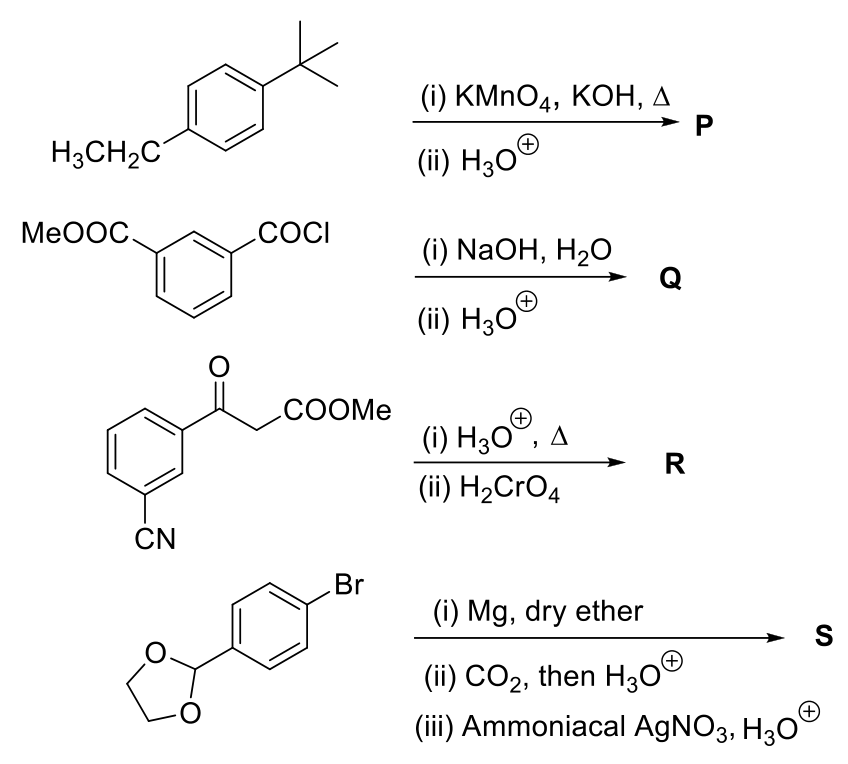
(1) 1-tert-Butyl-4-ethylbenzene → [(i) KMnO4, KOH, Δ; (ii) H3O+] → P. (2) Methyl 3-(chlorocarbonyl)benzoate (benzene with COOMe and COCl meta to each other) → [(i) NaOH, H2O; (ii) H3O+] → Q. (3) Methyl 3-(3-cyanophenyl)-3-oxopropanoate (a β-keto ester, ArCOCH2COOMe with CN meta on the ring) → [(i) H3O+, Δ; (ii) H2CrO4] → R. (4) 2-(4-Bromophenyl)-1,3-dioxolane (acetal-protected 4-bromobenzaldehyde) → [(i) Mg, dry ether; (ii) CO2, then H3O+; (iii) ammoniacal AgNO3, H3O+] → S.
Choose one or more options
Answer and worked solution

Official answer: C, D

P. Hot alkaline KMnOX4\ce{KMnO4} oxidises the ethyl group to COOH. The tert-butyl group has no benzylic H and survives. P = 4-tert-butylbenzoic acid, a monocarboxylic acid.

Q. NaOH hydrolyses both the acid chloride and the ester. Acidification gives isophthalic acid (benzene-1,3-dicarboxylic acid).

R.

  1. Hot acid hydrolyses the nitrile to COOH and the ester to a β\beta-keto acid.
  2. The β\beta-keto acid decarboxylates, giving 3-acetylbenzoic acid.
  3. Chromic acid oxidises the aryl methyl ketone to COOH.

R = isophthalic acid, so (C) is true.

S.

  1. The acetal protects the aldehyde while the Grignard reagent forms and is carboxylated.
  2. Acid work-up removes the acetal, giving 4-formylbenzoic acid.
  3. Tollens' reagent oxidises the CHO, giving terephthalic acid.

The options.

  • (A) False: P is not terephthalic acid (the dacron monomer), and the glyptal monomer is phthalic acid, not isophthalic acid.
  • (B) False: P is a monocarboxylic acid.
  • (D) True: R has no carbonyl α\alpha-H (it is a diacid), so it cannot undergo aldol condensation. S has no aldehyde, so it cannot undergo the Cannizzaro reaction.