The number of isomeric tetraenes (NOT containing -hybridized carbon atoms) that can be formed from the following reaction sequence is ________.
← JEE Advanced 2022 · Paper 2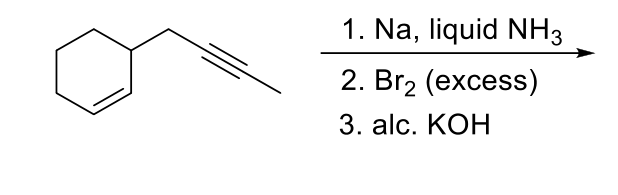
ChemistryInteger+3 / -1Question 42 of 54
JEE Advanced 2022 · Paper 2, Chemistry question 6
Answer and worked solution
Official answer: 2
Step by step.
- Na in liquid reduces the alkyne to the trans alkene; the ring C=C is untouched.
- Excess adds across both C=C bonds, giving two vicinal dibromides.
- Alcoholic KOH removes two HBr from each dibromide. Products with no carbon (no alkyne, no allene) are conjugated dienes:
- the ring becomes a cyclohexa-1,3-diene, with the side chain on the sp³ carbon next to the diene;
- the side chain becomes .
Count. The tetraene is 5-(buta-1,3-dien-1-yl)cyclohexa-1,3-diene. Its internal side-chain double bond can be E or Z, so there are 2 isomeric tetraenes. The ring carbon bearing the side chain is a stereocentre, but the product is formed racemic from racemic starting material.