Skip to content
dronacharya.ai
← JEE Advanced 2014 · Paper 2
ChemistryList match+3 / -1Question 37 of 60

JEE Advanced 2014 · Paper 2, Chemistry question 37

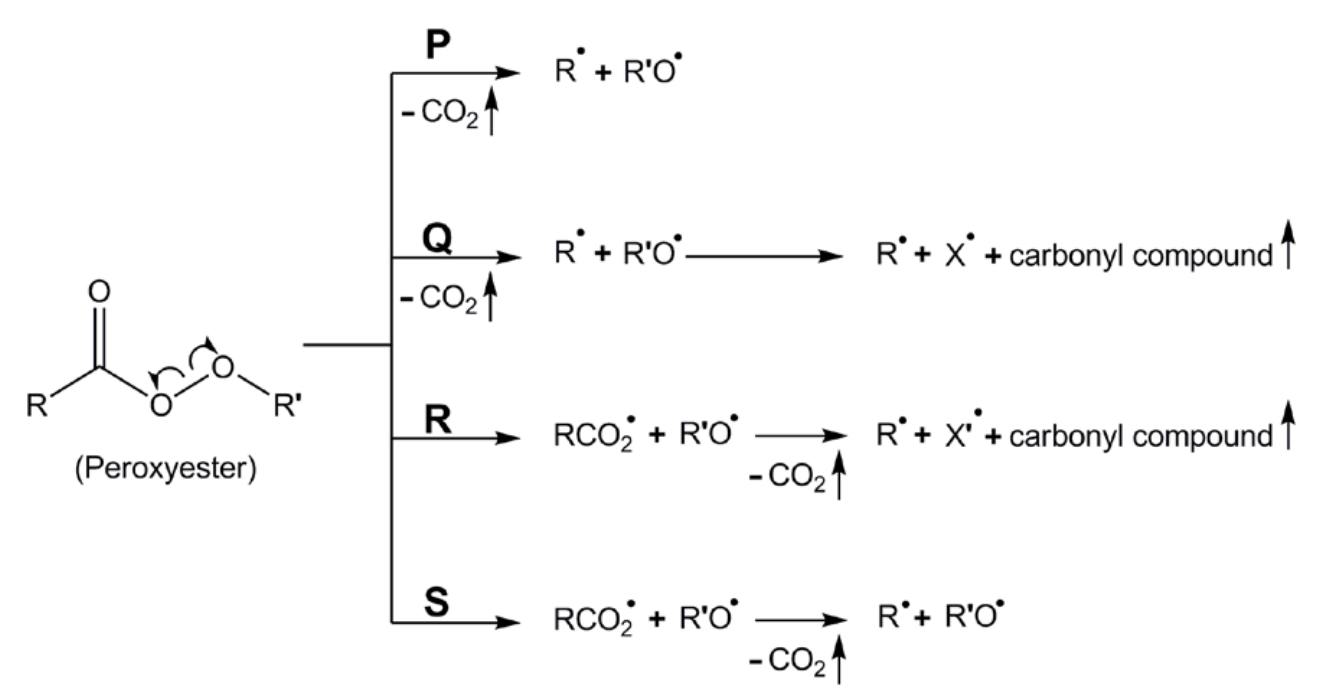
Different possible thermal decomposition pathways for peroxyesters are shown below. Match each pathway from List I with an appropriate structure from List II and select the correct answer using the code given below the lists.

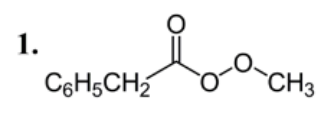
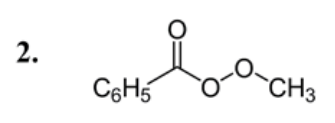
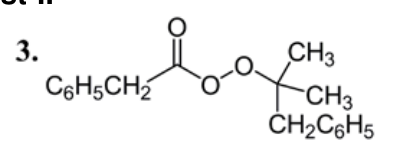
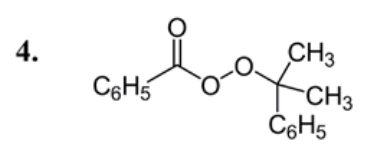
Peroxyester R-CO-O-O-R′ with curved arrows on the O-O bond; four thermal pathways. P: loses CO₂ to give R• + R′O•. Q: loses CO₂ to give R• + R′O•, then R′O• → R• + X• + carbonyl compound (gas). R: gives RCO₂• + R′O•, then loses CO₂ to give R• + X′• + carbonyl compound (gas). S: gives RCO₂• + R′O•, then loses CO₂ to give R• + R′O•.Methyl phenylperacetate, C₆H₅CH₂-CO-O-O-CH₃.Methyl perbenzoate, C₆H₅-CO-O-O-CH₃.C₆H₅CH₂-CO-O-O-C(CH₃)₂CH₂C₆H₅ (1,1-dimethyl-2-phenylethyl phenylperacetate).C₆H₅-CO-O-O-C(CH₃)₂C₆H₅ (cumyl perbenzoate).

List-I

  • P
    Pathway P
  • Q
    Pathway Q
  • R
    Pathway R
  • S
    Pathway S

List-II

  • 1
  • 2
  • 3
  • 4
Choose one option
Answer and worked solution

Official answer: A

What decides the pathway.

  • Concerted loss of COX2\ce{CO2} (P, Q) needs R to give a stable radical: benzyl (PhCHX2−CO−O−OX−\ce{PhCH2-CO-O-O-}). A benzoyloxy radical (PhCOX2 ⋅ \ce{PhCO2.}, R = Ph) loses COX2\ce{CO2} slowly, so phenyl peresters break stepwise (R, S).
  • Fragmentation of RX′O ⋅ \ce{R'O.} into a carbonyl compound and a radical (Q, R) needs a tertiary alkoxyl that can expel a stabilised radical: PhCHX2C(CHX3)X2O ⋅ →PhCHX2 ⋅ +(CHX3)X2CO\ce{PhCH2C(CH3)2O. -> PhCH2. + (CH3)2CO}, or cumyloxyl PhC(CHX3)X2O ⋅ →CHX3 ⋅ +PhCOCHX3\ce{PhC(CH3)2O. -> CH3. + PhCOCH3}. A methoxyl radical does not fragment.

Matching.

  • P: concerted, RX′O ⋅ \ce{R'O.} stays: benzyl perester of methanol, PhCHX2CO−O−OCHX3\ce{PhCH2CO-O-OCH3} → 1.
  • Q: concerted, then RX′O ⋅ \ce{R'O.} fragments: PhCHX2CO−O−OC(CHX3)X2CHX2Ph\ce{PhCH2CO-O-OC(CH3)2CH2Ph} → 3.
  • R: stepwise, then RX′O ⋅ \ce{R'O.} fragments: PhCO−O−OC(CHX3)X2Ph\ce{PhCO-O-OC(CH3)2Ph} → 4.
  • S: stepwise, RX′O ⋅ \ce{R'O.} stays: PhCO−O−OCHX3\ce{PhCO-O-OCH3} → 2.

(A) P → 1, Q → 3, R → 4, S → 2