Skip to content
dronacharya.ai
← JEE Advanced 2014 · Paper 2
ChemistrySingle correct+3 / -1Question 36 of 60

JEE Advanced 2014 · Paper 2, Chemistry question 36

Passage

Paragraph For Question 35 and 36

X and Y are two volatile liquids with molar weights of 10 g mol⁻¹ and 40 g mol⁻¹ respectively. Two cotton plugs, one soaked in X and the other soaked in Y, are simultaneously placed at the ends of a tube of length L = 24 cm, as shown in the figure. The tube is filled with an inert gas at 1 atmosphere pressure and a temperature of 300 K. Vapours of X and Y react to form a product which is first observed at a distance d cm from the plug soaked in X. Take X and Y to have equal molecular diameters and assume ideal behaviour for the inert gas and the two vapours.
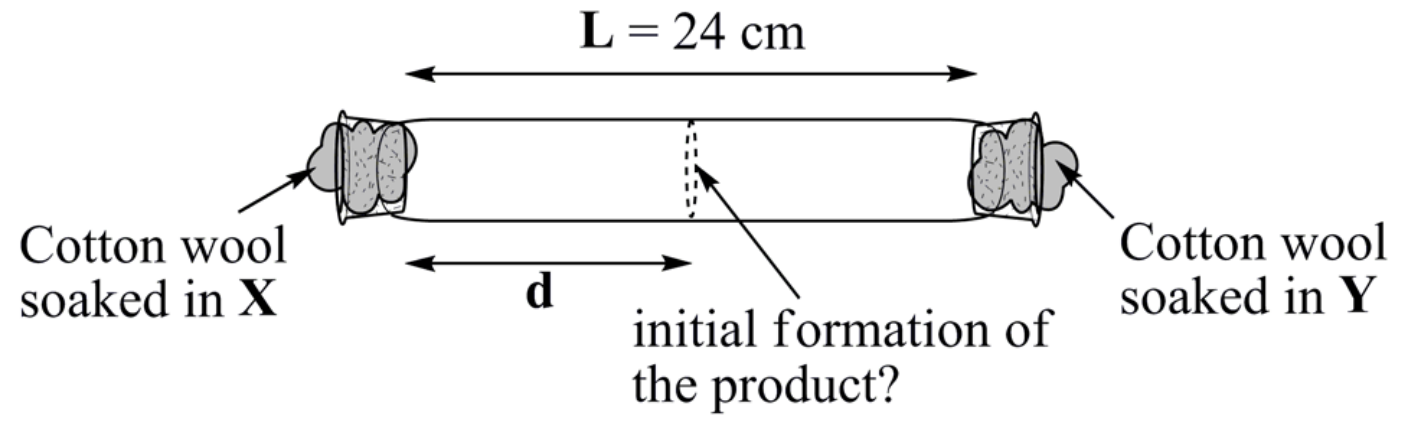
A horizontal tube of length L = 24 cm with cotton wool soaked in X plugging the left end and cotton wool soaked in Y plugging the right end; a dashed ring marks the initial formation of the product at distance d from the X end.

The experimental value of d is found to be smaller than the estimate obtained using Graham's law. This is due to

Choose one option
Answer and worked solution

Official answer: D

Why d is smaller. X covers less distance than Graham's law predicts, so its motion is hindered more than Y's.

The tube is filled with inert gas, so the vapours do not effuse freely: each molecule diffuses by colliding with the inert gas. X, being lighter, moves faster and so collides with the inert-gas molecules more often than Y does (equal molecular diameters). These frequent collisions slow X's net progress more than Graham's law allows.

The mean free path depends on the inert gas's number density and the molecular size, which are the same for both, so (A) and (B) are not the reason; (C) has the comparison the wrong way round.

(D)