Skip to content
dronacharya.ai
← JEE Advanced 2014 · Paper 2
ChemistrySingle correct+3 / -1Question 31 of 60

JEE Advanced 2014 · Paper 2, Chemistry question 31

Passage

Paragraph For Question 31 and 32

Schemes 1 and 2 describe sequential transformation of alkynes M and N. Consider only the major products formed in each step for both the schemes.
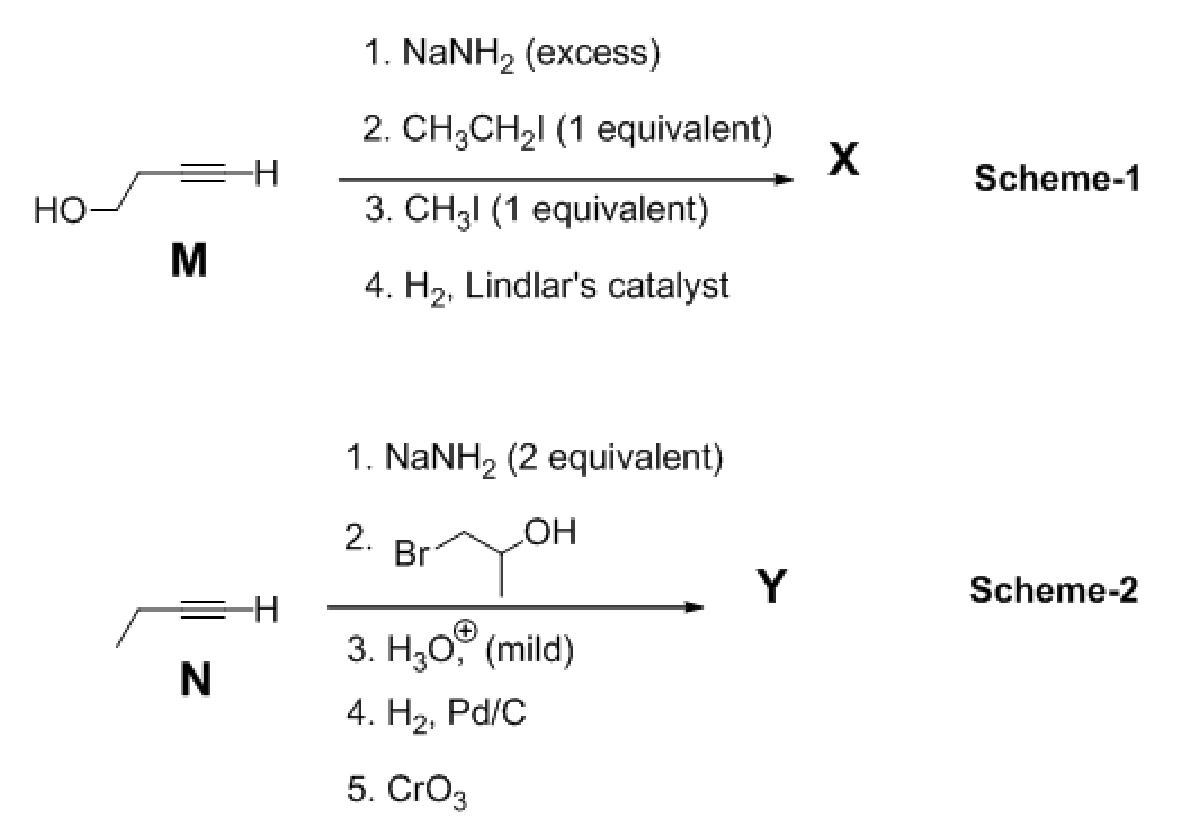
Scheme-1: M = HO-CH₂CH₂-C≡C-H treated with 1. NaNH₂ (excess); 2. CH₃CH₂I (1 equivalent); 3. CH₃I (1 equivalent); 4. H₂, Lindlar's catalyst gives X. Scheme-2: N = but-1-yne, CH₃CH₂-C≡C-H, treated with 1. NaNH₂ (2 equivalent); 2. BrCH₂CH(OH)CH₃; 3. H₃O⁺ (mild); 4. H₂, Pd/C; 5. CrO₃ gives Y.

The product X is

Choose one option
Answer and worked solution

Official answer: A

Scheme 1.

  1. Excess NaNHX2\ce{NaNH2} removes both acidic protons, giving the dianion X−X22−O−CHX2CHX2−C≡CX−\ce{^-O-CH2CH2-C#C^-}.
  2. One equivalent of ethyl iodide alkylates the more nucleophilic site, the acetylide carbon: X−X22−OCHX2CHX2C≡C−CHX2CHX3\ce{^-OCH2CH2C#C-CH2CH3}.
  3. Methyl iodide then alkylates the alkoxide: CHX3O−CHX2CHX2−C≡C−CHX2CHX3\ce{CH3O-CH2CH2-C#C-CH2CH3}.
  4. Lindlar's catalyst gives syn addition of HX2\ce{H2}: the cis alkene.

X is (Z)-1-methoxyhex-3-ene, CHX3OCHX2CHX2CH=CHCHX2CHX3\ce{CH3OCH2CH2CH=CHCH2CH3}, CX7HX14O\ce{C7H14O}.

(A)