Skip to content
dronacharya.ai
← JEE Advanced 2014 · Paper 2
ChemistrySingle correct+3 / -1Question 32 of 60

JEE Advanced 2014 · Paper 2, Chemistry question 32

Passage

Paragraph For Question 31 and 32

Schemes 1 and 2 describe sequential transformation of alkynes M and N. Consider only the major products formed in each step for both the schemes.
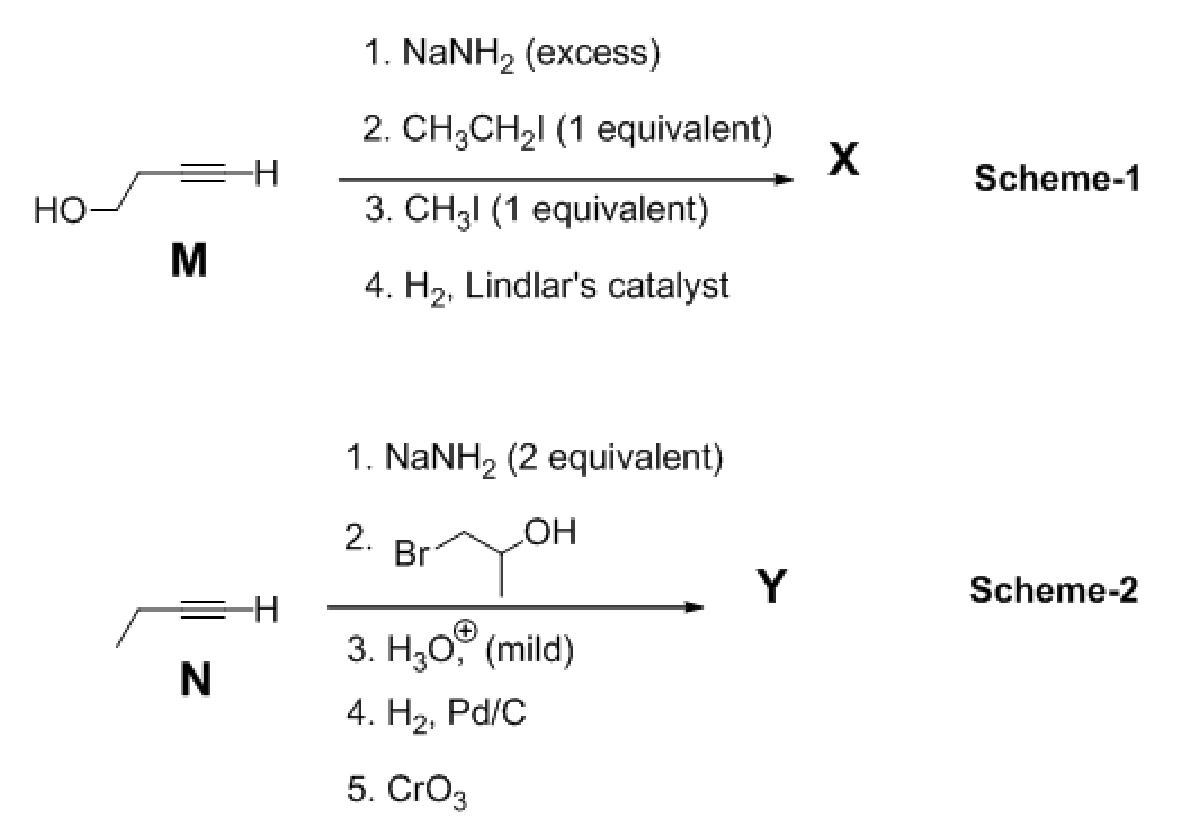
Scheme-1: M = HO-CH₂CH₂-C≡C-H treated with 1. NaNH₂ (excess); 2. CH₃CH₂I (1 equivalent); 3. CH₃I (1 equivalent); 4. H₂, Lindlar's catalyst gives X. Scheme-2: N = but-1-yne, CH₃CH₂-C≡C-H, treated with 1. NaNH₂ (2 equivalent); 2. BrCH₂CH(OH)CH₃; 3. H₃O⁺ (mild); 4. H₂, Pd/C; 5. CrO₃ gives Y.

The correct statement with respect to product Y is

Choose one option
Answer and worked solution

Official answer: C

Scheme 2 (N is but-1-yne).

  1. Two equivalents of NaNHX2\ce{NaNH2}: the acetylide CHX3CHX2C≡CX−\ce{CH3CH2C#C^-} forms, and the extra base deprotonates the bromohydrin's OH.
  2. The acetylide attacks the CHX2\ce{CH2} carbon (directly, or by opening the epoxide formed from the bromohydrin): CHX3CHX2C≡C−CHX2−CH(OX−)CHX3\ce{CH3CH2C#C-CH2-CH(O^-)CH3}.
  3. Mild acid gives hept-4-yn-2-ol.
  4. HX2\ce{H2}, Pd/C reduces the triple bond fully: heptan-2-ol.
  5. CrOX3\ce{CrO3} oxidises the secondary alcohol: Y = heptan-2-one, CHX3CO(CHX2)X4CHX3\ce{CH3CO(CH2)4CH3}, CX7HX14O\ce{C7H14O}.

Judging the options.

  • Y is a methyl ketone, so it gives a positive iodoform test; ketones do not reduce Tollens' reagent.
  • Y and X are both CX7HX14O\ce{C7H14O} with different functional groups (ketone versus ether + alkene): functional isomers. Y has no C=C, so it cannot be a geometrical isomer.

(C)