Paragraphs for Questions 35 and 36
P and Q are isomers of dicarboxylic acid . Both decolorize . On heating, P forms the cyclic anhydride.
Upon treatment with dilute alkaline , P as well as Q could produce one or more than one from S, T and U.
Passage
Paragraphs for Questions 35 and 36
P and Q are isomers of dicarboxylic acid . Both decolorize . On heating, P forms the cyclic anhydride.
Upon treatment with dilute alkaline , P as well as Q could produce one or more than one from S, T and U.
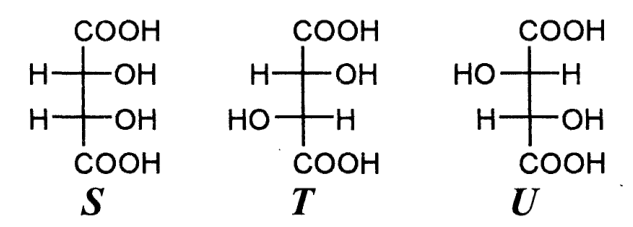
Compounds formed from P and Q are, respectively
Official answer: B
Identify P and Q. C₄H₄O₄ acids that decolorise bromine water are maleic and fumaric acid; the cis isomer, maleic acid (P), forms the cyclic anhydride; Q is fumaric acid.
syn-Dihydroxylation by cold alkaline KMnO₄:
(B)