Paragraphs for Questions 35 and 36
P and Q are isomers of dicarboxylic acid . Both decolorize . On heating, P forms the cyclic anhydride.
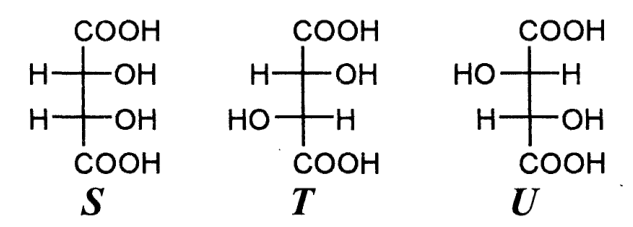
Upon treatment with dilute alkaline , P as well as Q could produce one or more than one from S, T and U.
Passage
Paragraphs for Questions 35 and 36
P and Q are isomers of dicarboxylic acid . Both decolorize . On heating, P forms the cyclic anhydride.
Upon treatment with dilute alkaline , P as well as Q could produce one or more than one from S, T and U.
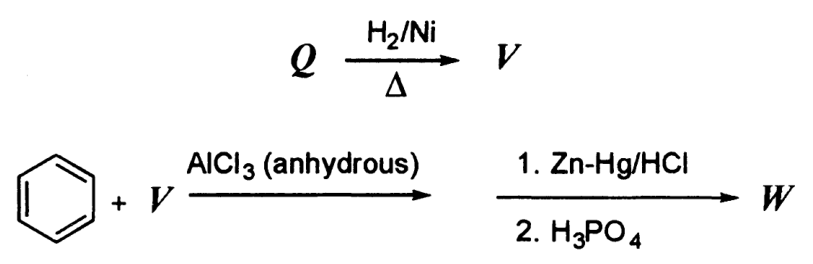
In the following reaction sequences V and W are, respectively
Official answer: A
V. Fumaric acid (Q) is hydrogenated to succinic acid, which on heating gives succinic anhydride.
W. Friedel-Crafts acylation of benzene with the anhydride gives 3-benzoylpropanoic acid; Clemmensen reduction gives 4-phenylbutanoic acid; H₃PO₄ closes the ring by intramolecular acylation to 1-tetralone.
(A)