Consider a disc rotating in the horizontal plane with a constant angular speed about its centre . The disc has a shaded region on one side of the diameter and an unshaded region on the other side as shown in the figure. When the disc is in the orientation as shown, two pebbles and are simultaneously projected at an angle towards . The velocity of projection is in the - plane and is same for both pebbles with respect to the disc. Assume that (i) they land back on the disc before the disc has completed rotation, (ii) their range is less than half the disc radius, and (iii) remains constant throughout. Then
← IIT-JEE 2012 · Paper 2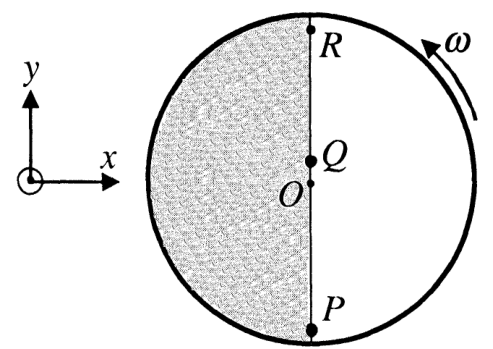
PhysicsSingle correct+3 / -1Question 6 of 60
IIT-JEE 2012 · Paper 2, Physics question 6
Answer and worked solution
Official answer: C
Ground frame. Once airborne the pebbles move with their launch velocity (relative to the disc) plus the disc's velocity at their launch points. The disc rotates counter-clockwise, so the velocity of the surface along the diameter PQR points to the right () on the lower side of O and to the left above O; P (at the rim, below O) and Q (just above O) therefore get these sideways velocities .
Where the boundary goes. In the flight time the dividing diameter turns counter-clockwise by : points of it below O move right by about , points above O move left.
- P starts at with sideways velocity to the right and lands at height (). It moves right by , while the boundary at its landing height has moved right by only . P lands to the right of the boundary: unshaded.
- Q starts just above O, and the boundary above O moves left, while Q's own small sideways velocity points left by less than the boundary's at its landing height (which is further from O). Q also lands to the right of the boundary: unshaded.
Both pebbles land in the unshaded region. The official key accepts (C) or (D).
(C) (key: C or D)