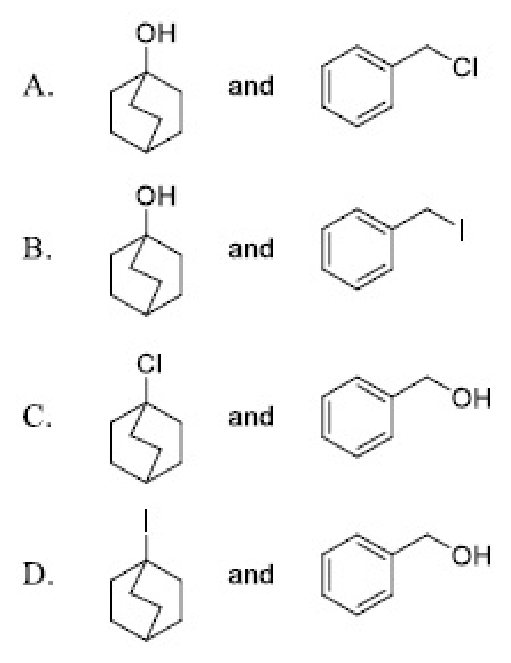
The following compound, 1-(benzyloxy)bicyclo[2.2.2]octane, can readily be prepared by Williamson ether synthesis by reaction between
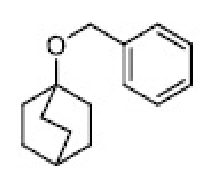
![Target: a bicyclo[2.2.2]octane whose bridgehead carbon carries O-CH2-C6H5 (benzyl ether).](/figures/kvpy-2018-p2/kvpy-2018-p2-che-q42-f1.png)
![Options (A)-(D): (A) bicyclo[2.2.2]octan-1-ol and benzyl chloride; (B) bicyclo[2.2.2]octan-1-ol and benzyl iodide; (C) 1-chlorobicyclo[2.2.2]octane and benzyl alcohol; (D) 1-iodobicyclo[2.2.2]octane and benzyl alcohol.](/figures/kvpy-2018-p2/kvpy-2018-p2-che-q42-f2.png)
From KVPY 2018 · Streams SB/SX
The following compound, 1-(benzyloxy)bicyclo[2.2.2]octane, can readily be prepared by Williamson ether synthesis by reaction between
![Target: a bicyclo[2.2.2]octane whose bridgehead carbon carries O-CH2-C6H5 (benzyl ether).](/figures/kvpy-2018-p2/kvpy-2018-p2-che-q42-f1.png)
![Options (A)-(D): (A) bicyclo[2.2.2]octan-1-ol and benzyl chloride; (B) bicyclo[2.2.2]octan-1-ol and benzyl iodide; (C) 1-chlorobicyclo[2.2.2]octane and benzyl alcohol; (D) 1-iodobicyclo[2.2.2]octane and benzyl alcohol.](/figures/kvpy-2018-p2/kvpy-2018-p2-che-q42-f2.png)
Worked solution
Williamson synthesis is an attack of an alkoxide on an alkyl halide. A bridgehead halide cannot undergo backside attack, so the bridgehead must carry the oxygen (as the alkoxide) and the benzyl group the halide. Iodide is the better leaving group, so bicyclo[2.2.2]octan-1-ol with benzyl iodide reacts most readily.
(B)
Every past question tagged to the same part of the syllabus, with solutions.
Timed, in the real format, and marked the moment you submit.