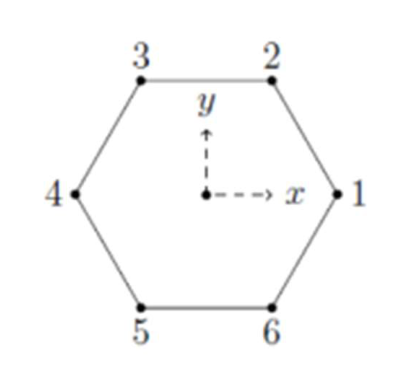
Six objects are placed at the vertices of a regular hexagon. The geometric center of the hexagon is at the origin with objects 1 and 4 on the x-axis (see figure). The mass of the kth object is mk=kiM∣cosθk∣ where i is an integer, M is a constant with dimension of mass, and θk is the angular position of the kth vertex measured from the positive x-axis in the counter-clockwise sense. If the net gravitational force on a body at the centroid vanishes, the value of i is
Answer and worked solutionTry it first, then open this to check your working.
Official answerA
Worked solution
The vertices are at θk=0∘,60∘,120∘,180∘,240∘,300∘, with ∣cosθk∣=1,21,21,1,21,21. All vertices are at the same distance, so the net pull is proportional to ∑mkr^k.
y-component, from sinθk=0,23,23,0,−23,−23: Fy∝21(2i+3i−5i−6i). For this to vanish we need 2i+3i=5i+6i, which holds only for i=0 (for i>0 the right side is larger, for i<0 the left side is).
Check i=0: masses M,2M,2M,M,2M,2M are symmetric under 180∘ rotation, so Fx=0 as well.
(A)
Practise this topic
Every past question tagged to the same part of the syllabus, with solutions.