Skip to content
dronacharya.ai
KVPY 2017PhysicsSingle correct+1 / -0.25

Physics, question 19

From KVPY 2017 · Stream SA · 19 Nov

A uniform metallic wire of length LL is mounted in two configurations. In configuration 1 (triangle), it is an equilateral triangle and a voltage VV is applied to corners A and B. In configuration 2 (circle), it is bent in the form of a circle, and the potential VV is applied at diametrically opposite points P and Q. The ratio of the power dissipated in configuration 1 to configuration 2 is
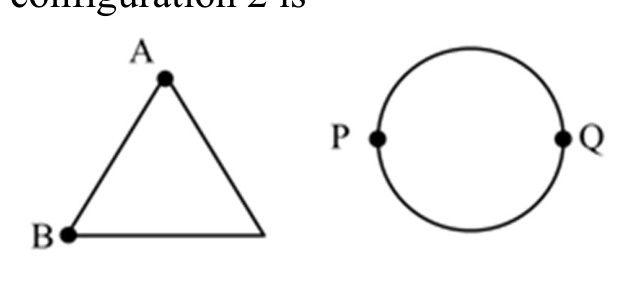
Left: an equilateral triangle of wire with the voltage applied between vertices A (top) and B (bottom left). Right: a circular loop of wire with the voltage applied at diametrically opposite points P (left) and Q (right).
Choose one option
Answer and worked solutionTry it first, then open this to check your working.
Official answerB

Worked solution

Let the whole wire have resistance RR.

  • Triangle: each side is R/3R/3. Between A and B, one side (R/3R/3) is in parallel with the other two in series (2R/32R/3):
    R1=(R/3)(2R/3)R=2R9.R_1 = \frac{(R/3)(2R/3)}{R} = \frac{2R}9.
  • Circle: the two halves, R/2R/2 each, are in parallel between P and Q: R2=R4R_2 = \dfrac R4.

At the same voltage P=V2/ReqP = V^2/R_{eq}, so
P1P2=R2R1=R/42R/9=98.\frac{P_1}{P_2} = \frac{R_2}{R_1} = \frac{R/4}{2R/9} = \frac98.

(B)

Practise this topic

Every past question tagged to the same part of the syllabus, with solutions.

full papers
153
questions
13,073
worked solutions
13,054

Sit a paper tonight. See exactly where you stand.

Timed, in the real format, and marked the moment you submit.