Skip to content
dronacharya.ai
KVPY 2013ChemistrySingle correct+1 / -0.25

Chemistry, question 59

From KVPY 2013 · Streams SB/SX

The order of SN1\mathrm{S_N1} reactivity in aqueous acetic acid solution for the compounds

shown is
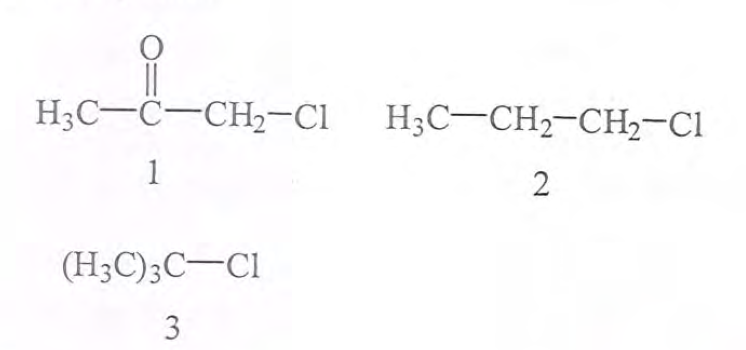
Three structures drawn side by side and numbered. Structure 1 is H3C-C(=O)-CH2-Cl (chloroacetone), with the carbonyl O drawn above the carbon. Structure 2 is H3C-CH2-CH2-Cl (1-chloropropane). Structure 3, below them, is (H3C)3C-Cl (tert-butyl chloride).
Choose one option
Answer and worked solutionTry it first, then open this to check your working.
Official answerC

Worked solution

SN1\mathrm{S_N1} rates follow carbocation stability, since the slow step is ionisation to RX+\ce{R+}.

  • 3, (CHX3)X3C−Cl\ce{(CH3)3C-Cl} ionises to the tertiary cation, stabilised by three alkyl groups by hyperconjugation and induction: fastest.
  • 2, CHX3CHX2CHX2−Cl\ce{CH3CH2CH2-Cl} would need a primary cation: slow, but at least no destabilising group is present.
  • 1, CHX3COCHX2−Cl\ce{CH3COCH2-Cl} would need a cation adjacent to a carbonyl. The strongly electron-withdrawing C=O\ce{C=O} pulls density away from the already electron-poor centre, so this is the slowest of the three. (Such α\alpha-halo ketones are reactive by SN2\mathrm{S_N2}, not SN1\mathrm{S_N1}.)

3>2>13 > 2 > 1

(C)

Practise this topic

Every past question tagged to the same part of the syllabus, with solutions.

full papers
153
questions
13,073
worked solutions
13,054

Sit a paper tonight. See exactly where you stand.

Timed, in the real format, and marked the moment you submit.