Skip to content
dronacharya.ai
← JEE Advanced 2026 · Paper 2
PhysicsNumerical+2Question 36 of 54

JEE Advanced 2026 · Paper 2, Physics question 18

Passage

Question Stem for Question Nos. 17 and 18

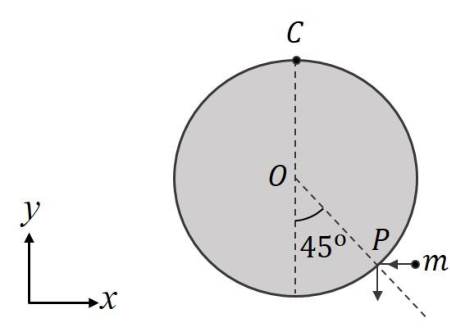
A uniform circular disk of radius 0.20.2 m and mass 11 kg is pivoted at its top point CC such that it can rotate freely around CC in the XYXY plane, as shown in the figure. Initially, when the disk is at rest, a particle of mass 2020 g, travelling along negative xx direction in the XYXY plane with speed 100100 ms−1^{-1}, hits the circumference of the disk at a point PP. After collision the particle moves along negative yy direction at a speed of 9090 ms−1^{-1}.
[Given: the acceleration due to gravity (g) =−10 ȷ^=-10\,\hat\jmath ms−2^{-2}]

A disk with centre O hangs from its top point C. Point P is on the rim below and to the right of O, with OP at 45° to the downward vertical through O. A particle m approaches P moving in the −x direction; after the collision it moves in the −y direction. Axes x (right) and y (up) are drawn at the left.

Amount of energy loss (in J) in the collision is:

Answer and worked solution

Official answer: 17

The particle's kinetic energy is 12(0.02)(1002)=100\frac12(0.02)(100^2)=100 J before and 12(0.02)(902)=81\frac12(0.02)(90^2)=81 J after. The disk takes 1.531.53 J (previous question). So
loss=100−81−1.53≈17.5 J.\text{loss}=100-81-1.53\approx17.5\text{ J}.