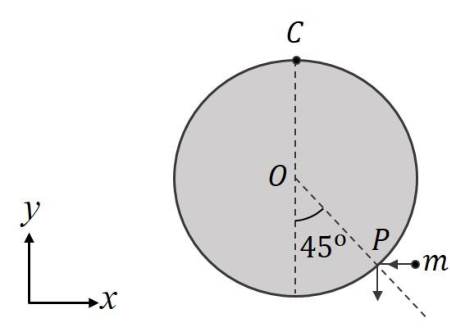
A uniform circular disk of radius 0.2 m and mass 1 kg is pivoted at its top point C such that it can rotate freely around C in the XY plane, as shown in the figure. Initially, when the disk is at rest, a particle of mass 20 g, travelling along negative x direction in the XY plane with speed 100 ms−1, hits the circumference of the disk at a point P. After collision the particle moves along negative y direction at a speed of 90 ms−1. [Given: the acceleration due to gravity (g) =−10^ ms−2]
After the collision the disk starts to rotate around point C in the XY plane. The maximum change in the height (in m) of its center O is:
Answer and worked solution
Official answer: 0.14
Take the pivot C as origin. Then O=(0,−0.2) and P=(0.2sin45∘,−0.2−0.2cos45∘)=(0.1414,−0.3414) m.
Angular momentum about C is conserved: the pivot force acts at C, and gravity gives no impulse during the brief collision. For the particle (m=0.02 kg):