Skip to content
dronacharya.ai
← JEE Advanced 2026 · Paper 2
PhysicsNumerical+2Question 33 of 54

JEE Advanced 2026 · Paper 2, Physics question 15

Passage

Question Stem for Question Nos. 15 and 16

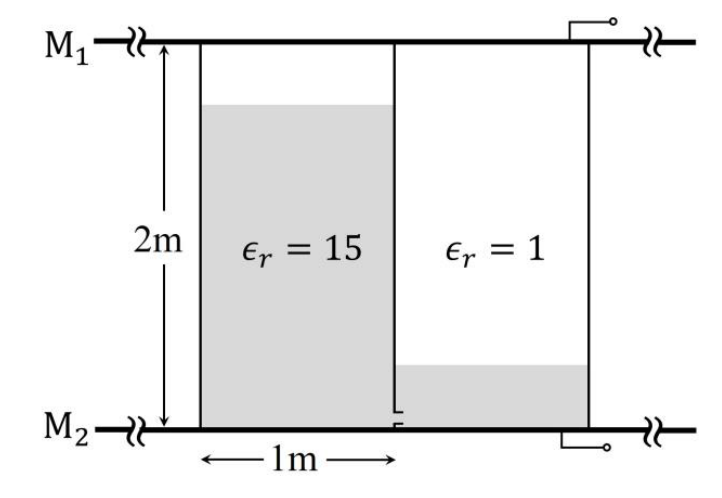
A container of height 2 m, length 2 m and breadth 1 m is made of insulating vertical walls and two large area horizontal metal plates (M1\mathrm M_1 and M2\mathrm M_2) which extend far beyond the vertical walls in all directions. The container is partitioned into two equal chambers with a thin insulating vertical wall. The partition wall contains a small hole of cross-sectional area 10\sqrt{10} cm2^2 near its bottom edge. Initially the hole is closed and the left chamber of the container is completely filled with a liquid of dielectric constant ϵr=15\epsilon_r=15 and the right chamber is empty (ϵr=1)(\epsilon_r=1). At time t=0t=0, the hole is opened and the liquid flows from the left chamber to the right chamber. In both the chambers, the space above the liquid has ϵr=1\epsilon_r=1 and is maintained at atmospheric pressure. The schematic of the container at a time t>0t>0 is shown in the figure.
[Given: acceleration due to gravity is 1010 ms−2^{-2}.]

Cross-section of the container between horizontal plates M₁ (top) and M₂ (bottom), 2 m apart, the plates extending beyond the walls. A thin partition divides it into two 1 m wide chambers: the left holds liquid (ε_r = 15) to a large height, the right a shallow layer (ε_r = 1 above). A small hole sits at the bottom of the partition.

The height (in m) of the liquid in left chamber at t=500t=500 s is:

Answer and worked solution

Official answer: 1.25

Each chamber has base area A=1×1=1A=1\times1=1 m², and the hole has area a=10×10−4a=\sqrt{10}\times10^{-4} m². The liquid levels h1h_1 (left) and h2h_2 (right) satisfy h1+h2=2h_1+h_2=2. Let Δ=h1−h2\Delta=h_1-h_2.

The outflow speed through the hole is 2gΔ\sqrt{2g\Delta}, so
dΔdt=2dh1dt=−2aA20Δ  ⟹  dΔdt=−aA20=−200×10−4≈−1.414×10⁻³ s−1.\frac{d\Delta}{dt}=2\frac{dh_1}{dt}=-\frac{2a}{A}\sqrt{20\Delta}\implies\frac{d\sqrt\Delta}{dt}=-\frac aA\sqrt{20}=-\sqrt{200}\times10^{-4}\approx-1.414\times10^{-3}\ \text{s}^{-1}.

Δ\sqrt{\Delta} falls linearly from 2\sqrt2, reaching 0 at t=1000t=1000 s. At t=500t=500 s, Δ=22\sqrt\Delta=\frac{\sqrt2}2, so Δ=0.5\Delta=0.5 and
h1=2+0.52=1.25 m.h_1=\frac{2+0.5}2=1.25\text{ m}.