Skip to content
dronacharya.ai
← JEE Advanced 2026 · Paper 2
PhysicsMultiple correct+4 / -1Question 23 of 54

JEE Advanced 2026 · Paper 2, Physics question 5

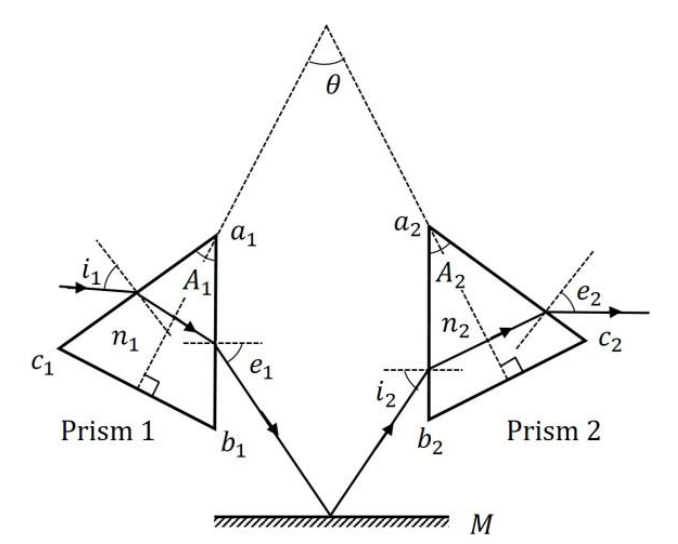
Consider two isosceles prisms 1 and 2 with prism angles A1A_1 and A2A_2 and refractive indices n1n_1 and n2n_2, respectively, as shown in the figure. The faces a1b1a_1b_1 and a2b2a_2b_2 are parallel to each other and perpendicular to the mirror MM. If a ray of light is incident on the face a1c1a_1c_1 and emerges from the face a2c2a_2c_2, then the correct statement(s) is/are:

Two triangular prisms standing on either side of a horizontal mirror M. Prism 1 (left, apex a₁ at top, vertices c₁ and b₁; apex angle A₁, index n₁): a ray enters face a₁c₁ at incidence i₁ and leaves the vertical face a₁b₁ at angle e₁, going down to M. The reflected ray rises to prism 2 (apex a₂, vertices b₂ and c₂; apex angle A₂, index n₂), enters the vertical face a₂b₂ at angle i₂ and leaves face a₂c₂ at angle e₂. In each prism a dashed line runs from the apex perpendicular to the base (c₁b₁, c₂b₂; right-angle marks), i.e. along its symmetry axis; these two axes, extended upward beyond a₁ and a₂, meet above at angle θ.
Choose one or more options
Answer and worked solution

Official answer: A, C, D

Key fact. The faces a1b1a_1b_1 and a2b2a_2b_2 are vertical and the mirror is horizontal. Their normals are horizontal, and reflection at MM only reverses the vertical component of the ray. So the ray leaving a1b1a_1b_1 at angle e1e_1 meets a2b2a_2b_2 at the same angle: i2=e1i_2=e_1.

At minimum deviation in an isosceles prism, the incidence and emergence angles are equal and sin⁡i=nsin⁡A2\sin i=n\sin\frac A2.

  • (D) Prism 1 at minimum deviation: sin⁡e1=n1sin⁡A12\sin e_1=n_1\sin\frac{A_1}2, and i2=e1i_2=e_1. True (no condition on prism 2 is needed).
  • (A) Both at minimum deviation: n1sin⁡A12=sin⁡e1=sin⁡i2=n2sin⁡A22n_1\sin\frac{A_1}2=\sin e_1=\sin i_2=n_2\sin\frac{A_2}2, so n2n1=sin⁡(A1/2)sin⁡(A2/2)\dfrac{n_2}{n_1}=\dfrac{\sin(A_1/2)}{\sin(A_2/2)}. True.
  • (B) Prism 2 at minimum deviation gives sin⁡i2=n2sin⁡A22\sin i_2=n_2\sin\frac{A_2}2, i.e. a condition on e1e_1, not on i1i_1. It holds for i1i_1 only if prism 1 is also symmetric. Not always true.
  • (C) The dashed lines are the prisms' symmetry axes. Each makes angle A2\frac{A}2 with the vertical face, so θ=A12+A22\theta=\frac{A_1}2+\frac{A_2}2. For thin prisms δm=(n−1)A\delta_m=(n-1)A, so
    θ=δm12(n1−1)+δm22(n2−1).\theta=\frac{\delta_{m1}}{2(n_1-1)}+\frac{\delta_{m2}}{2(n_2-1)}. True.