Skip to content
dronacharya.ai
← JEE Advanced 2024 · Paper 2
PhysicsInteger+4Question 29 of 51

JEE Advanced 2024 · Paper 2, Physics question 12

An infinitely long thin wire, having a uniform charge density per unit length of 5 nC/m5\,\mathrm{nC/m}, is passing through a spherical shell of radius 1 m1\,\mathrm{m}, as shown in the figure. A 10 nC10\,\mathrm{nC} charge is distributed uniformly over the spherical shell. If the configuration of the charges remains static, the magnitude of the potential difference between points P and R, in Volt, is _____.

[Given: In SI units 14πε0=9×10⁹\dfrac{1}{4\pi\varepsilon_0} = 9\times10^9, ln⁡2=0.7\ln 2 = 0.7. Ignore the area pierced by the wire.]
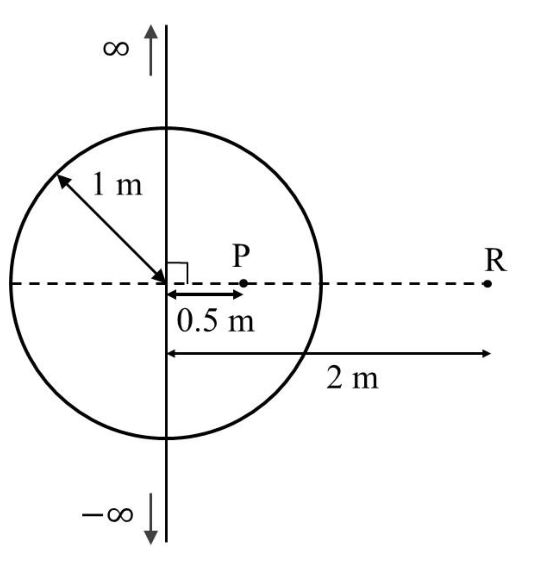
A spherical shell of radius 1 m with an infinitely long straight wire passing vertically through its centre (extending to +∞ and −∞). A horizontal dashed line through the centre, perpendicular to the wire, carries point P inside the shell at 0.5 m from the wire and point R outside the shell at 2 m from the wire.
Answer and worked solution

Official answer: 171

P and R lie on the line through the centre perpendicular to the wire: P at 0.50.5 m (inside the shell), R at 22 m (outside).

Shell, Q=10Q=10 nC.

  • VP=kQR=90V_P=\dfrac{kQ}{R}=90 V
  • VR=kQ2=45V_R=\dfrac{kQ}{2}=45 V
  • Difference: 4545 V

Wire, λ=5\lambda=5 nC/m.
VP−VR=2kλln⁡rRrP=2⋅9×109⋅5×10−9⋅ln⁡4=90⋅1.4=126 V.V_P-V_R=2k\lambda\ln\frac{r_R}{r_P}=2\cdot9\times10^9\cdot5\times10^{-9}\cdot\ln4=90\cdot1.4=126\ \mathrm V.

Both contributions have the same sign, so ∣VP−VR∣=45+126=171|V_P-V_R|=45+126=171 V.