Skip to content
dronacharya.ai
← JEE Advanced 2024 · Paper 2
PhysicsInteger+4Question 28 of 51

JEE Advanced 2024 · Paper 2, Physics question 11

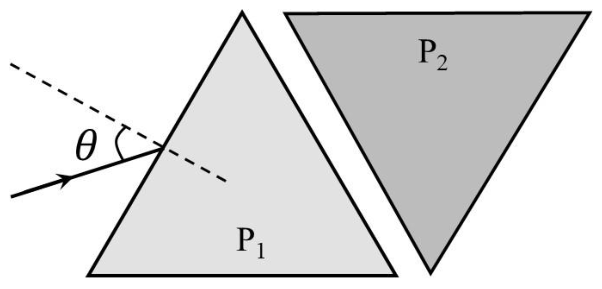
Two equilateral-triangular prisms P₁ and P₂ are kept with their sides parallel to each other, in vacuum, as shown in the figure. A light ray enters prism P₁ at an angle of incidence θ\theta such that the outgoing ray undergoes minimum deviation in prism P₂. If the respective refractive indices of P₁ and P₂ are 32\sqrt{\dfrac32} and 3\sqrt3, then θ=sin⁡−1[32sin⁡(πβ)]\theta = \sin^{-1}\left[\sqrt{\dfrac32}\sin\left(\dfrac{\pi}{\beta}\right)\right], where the value of β\beta is _____.

Two equilateral prisms side by side: P₁ (light grey) with apex up on the left, and P₂ (darker grey) inverted with apex down on the right, its left face parallel to and just separated from P₁'s right face. A light ray comes from the left and strikes P₁'s left face at angle of incidence θ, measured from the dashed normal to that face.
Answer and worked solution

Official answer: 12

P₂ at minimum deviation. With A=60∘A=60^\circ and n2=3n_2=\sqrt3, the internal angle is r=30∘r=30^\circ. So
sin⁡i=3sin⁡30∘=32,i=60∘.\sin i=\sqrt3\sin30^\circ=\frac{\sqrt3}{2},\qquad i=60^\circ.

Exit from P₁. P₂'s entry face is parallel to P₁'s exit face, so the ray leaves P₁ at 60∘60^\circ to the normal:
sin⁡60∘=32sin⁡r2  ⟹  sin⁡r2=3/23/2=12,r2=45∘.\sin60^\circ=\sqrt{\tfrac32}\sin r_2\implies\sin r_2=\frac{\sqrt3/2}{\sqrt{3/2}}=\frac{1}{\sqrt2},\qquad r_2=45^\circ.

Entry into P₁. r1=A−r2=15∘r_1=A-r_2=15^\circ, so
sin⁡θ=32sin⁡15∘=32sin⁡π12  ⟹  β=12.\sin\theta=\sqrt{\tfrac32}\sin15^\circ=\sqrt{\tfrac32}\sin\frac{\pi}{12}\implies\beta=12.