A thin uniform rod of length and certain mass is kept on a frictionless horizontal table with a massless string of length fixed to one end (top view is shown in the figure). The other end of the string is pivoted to a point O. If a horizontal impulse is imparted to the rod at a distance from the mid-point of the rod (see figure), then the rod and string revolve together around the point O, with the rod remaining aligned with the string. In such a case, the value of is _____.
← JEE Advanced 2024 · Paper 1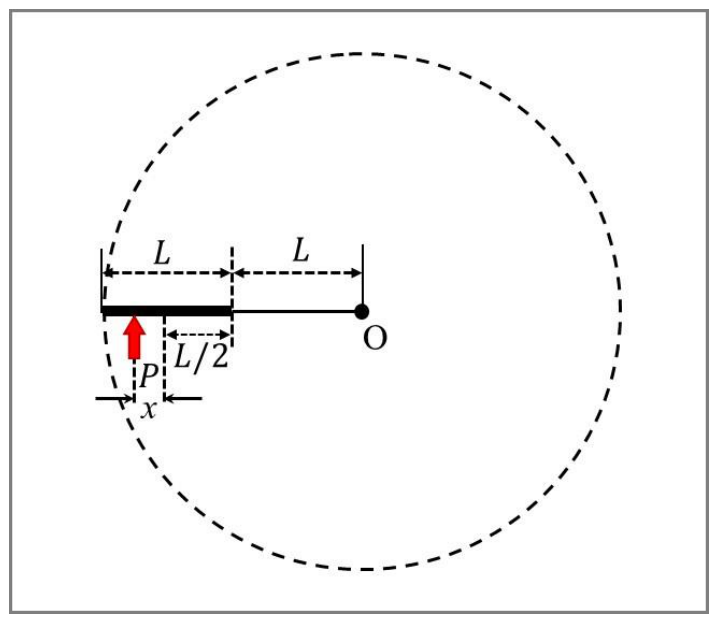
PhysicsInteger+4Question 30 of 51
JEE Advanced 2024 · Paper 1, Physics question 13
Answer and worked solution
Official answer: 18
For rod and string to revolve together, right after the impulse the rod must move as if rotating rigidly about O with some angular velocity .
- The rod's centre is from O, so .
- The rod itself turns at .
The string can only pull along its length, perpendicular to these velocities, so the impulse supplies both:
- Linear: .
- Angular about the centre: .
Dividing: , so .
(Check: the end tied to the string moves at , matching rotation about O, so the string needs no impulsive tension.)