Skip to content
dronacharya.ai
← JEE Advanced 2024 · Paper 1
ChemistryList match+3 / -1Question 51 of 51

JEE Advanced 2024 · Paper 1, Chemistry question 17

List-I contains various reaction sequences and List-II contains different phenolic compounds. Match each entry in List-I with the appropriate entry in List-II and choose the correct option.

List-I

  • P
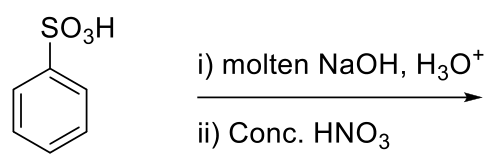
    Benzenesulfonic acid, treated with: i) molten NaOH, HX3OX+\ce{H3O+}; ii) Conc. HNOX3\ce{HNO3}
    Benzenesulfonic acid (benzene ring with SO₃H) reacts with i) molten NaOH, H₃O⁺ (above the arrow) and ii) Conc. HNO₃ (below the arrow).
  • Q
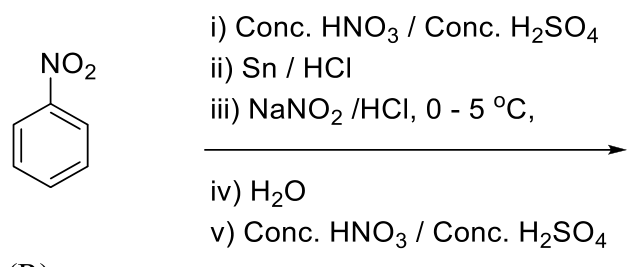
    Nitrobenzene, treated with: i) Conc. HNOX3\ce{HNO3} / Conc. HX2SOX4\ce{H2SO4}; ii) Sn / HCl; iii) NaNOX2\ce{NaNO2} / HCl, 0 - 5 °C; iv) HX2O\ce{H2O}; v) Conc. HNOX3\ce{HNO3} / Conc. HX2SOX4\ce{H2SO4}
    Nitrobenzene (benzene ring with NO₂) reacts with i) Conc. HNO₃ / Conc. H₂SO₄; ii) Sn / HCl; iii) NaNO₂ / HCl, 0-5 °C (above the arrow) and iv) H₂O; v) Conc. HNO₃ / Conc. H₂SO₄ (below the arrow).
  • R
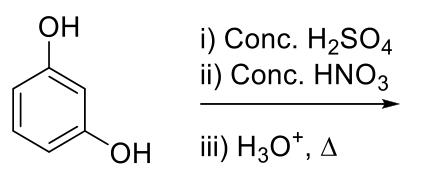
    Benzene-1,3-diol (resorcinol), treated with: i) Conc. HX2SOX4\ce{H2SO4}; ii) Conc. HNOX3\ce{HNO3}; iii) HX3OX+\ce{H3O+}, Δ\Delta
    Resorcinol (benzene ring with two OH groups meta to each other) reacts with i) Conc. H₂SO₄; ii) Conc. HNO₃ (above the arrow) and iii) H₃O⁺, Δ (below the arrow).
  • S
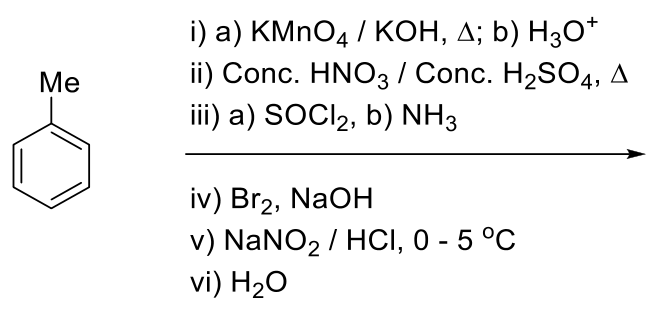
    Toluene, treated with: i) a) KMnOX4\ce{KMnO4} / KOH, Δ\Delta; b) HX3OX+\ce{H3O+}; ii) Conc. HNOX3\ce{HNO3} / Conc. HX2SOX4\ce{H2SO4}, Δ\Delta; iii) a) SOClX2\ce{SOCl2}, b) NHX3\ce{NH3}; iv) BrX2\ce{Br2}, NaOH; v) NaNOX2\ce{NaNO2} / HCl, 0 - 5 °C; vi) HX2O\ce{H2O}
    Toluene (benzene ring with Me) reacts with i) a) KMnO₄ / KOH, Δ; b) H₃O⁺; ii) Conc. HNO₃ / Conc. H₂SO₄, Δ; iii) a) SOCl₂, b) NH₃ (above the arrow) and iv) Br₂, NaOH; v) NaNO₂ / HCl, 0-5 °C; vi) H₂O (below the arrow).

List-II

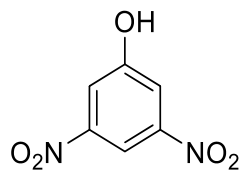
  • 1
    3,5-Dinitrophenol: phenol with NO₂ groups at both meta positions.
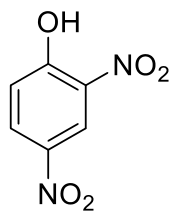
  • 2
    2,4-Dinitrophenol: phenol with NO₂ ortho and para to OH.
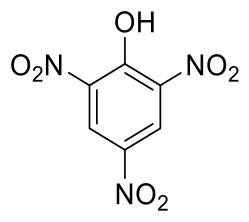
  • 3
    2,4,6-Trinitrophenol (picric acid): phenol with NO₂ at both ortho positions and the para position.
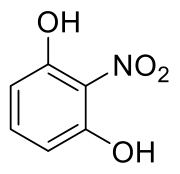
  • 4
    2-Nitrobenzene-1,3-diol: benzene ring with OH at C1 and C3 and NO₂ at C2, between them.
  • 5
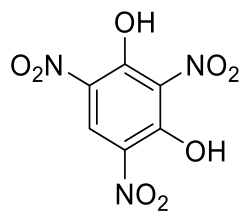
    2,4,6-Trinitrobenzene-1,3-diol (styphnic acid): benzene ring with OH at C1 and C3 and NO₂ at C2, C4 and C6.
Choose one option
Answer and worked solution

Official answer: C

  • (P) PhSOX3H\ce{PhSO3H} fused with NaOH, then HX3OX+\ce{H3O+}, gives phenol; conc. HNOX3\ce{HNO3} gives 2,4,6-trinitrophenol (picric acid) → (3).
  • (Q) Nitrobenzene is nitrated to m-dinitrobenzene; Sn/HCl gives m-phenylenediamine; double diazotisation then hydrolysis gives resorcinol; nitration gives 2,4,6-trinitroresorcinol (styphnic acid) → (5).
  • (R) Resorcinol: conc. HX2SOX4\ce{H2SO4} sulfonates C4 and C6 (blocking groups); HNOX3\ce{HNO3} nitrates C2; HX3OX+\ce{H3O+}, Δ\Delta removes the SOX3H\ce{SO3H} groups: 2-nitroresorcinol → (4).
  • (S) Toluene is oxidised by KMnOX4\ce{KMnO4} to benzoic acid; nitration gives 3,5-dinitrobenzoic acid; SOClX2\ce{SOCl2}/NHX3\ce{NH3} gives the amide; Hofmann bromamide gives 3,5-dinitroaniline; diazotisation and HX2O\ce{H2O} give 3,5-dinitrophenol → (1).

Option (C).