Skip to content
dronacharya.ai
← JEE Advanced 2024 · Paper 1
ChemistryList match+3 / -1Question 50 of 51

JEE Advanced 2024 · Paper 1, Chemistry question 16

List-I contains various reaction sequences and List-II contains the possible products. Match each entry in List-I with the appropriate entry in List-II and choose the correct option.

List-I

  • P
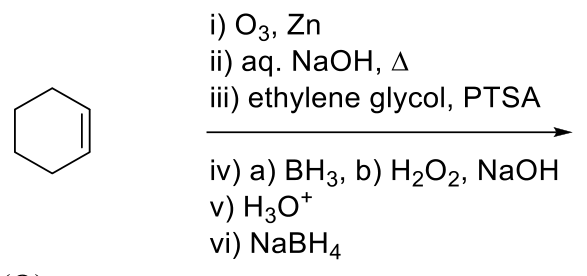
    Cyclohexene, treated with: i) OX3\ce{O3}, Zn; ii) aq. NaOH, Δ\Delta; iii) ethylene glycol, PTSA; iv) a) BHX3\ce{BH3}, b) HX2OX2\ce{H2O2}, NaOH; v) HX3OX+\ce{H3O+}; vi) NaBHX4\ce{NaBH4}
    Cyclohexene (six-membered ring with one C=C) reacts with i) O₃, Zn; ii) aq. NaOH, Δ; iii) ethylene glycol, PTSA (above the arrow) and iv) a) BH₃, b) H₂O₂, NaOH; v) H₃O⁺; vi) NaBH₄ (below the arrow).
  • Q
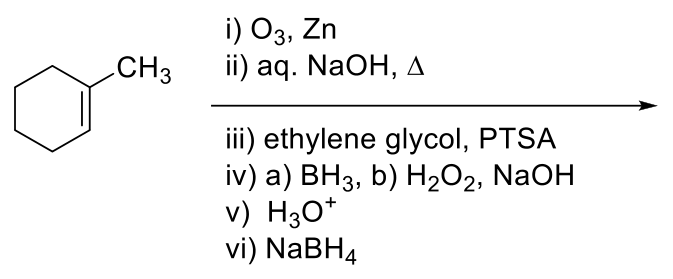
    1-Methylcyclohexene, treated with: i) OX3\ce{O3}, Zn; ii) aq. NaOH, Δ\Delta; iii) ethylene glycol, PTSA; iv) a) BHX3\ce{BH3}, b) HX2OX2\ce{H2O2}, NaOH; v) HX3OX+\ce{H3O+}; vi) NaBHX4\ce{NaBH4}
    1-Methylcyclohexene (cyclohexene ring with CH₃ on one alkene carbon) reacts with i) O₃, Zn; ii) aq. NaOH, Δ (above the arrow) and iii) ethylene glycol, PTSA; iv) a) BH₃, b) H₂O₂, NaOH; v) H₃O⁺; vi) NaBH₄ (below the arrow).
  • R
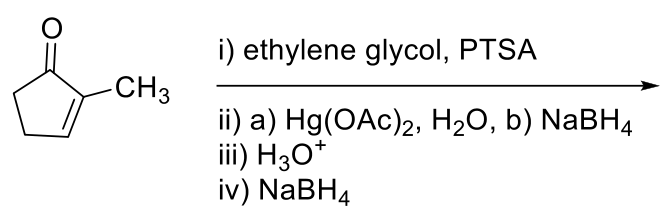
    2-Methylcyclopent-2-en-1-one, treated with: i) ethylene glycol, PTSA; ii) a) Hg(OAc)X2\ce{Hg(OAc)2}, HX2O\ce{H2O}, b) NaBHX4\ce{NaBH4}; iii) HX3OX+\ce{H3O+}; iv) NaBHX4\ce{NaBH4}
    2-Methylcyclopent-2-en-1-one (cyclopentenone with C=O and a CH₃ on the alkene carbon next to it) reacts with i) ethylene glycol, PTSA (above the arrow) and ii) a) Hg(OAc)₂, H₂O, b) NaBH₄; iii) H₃O⁺; iv) NaBH₄ (below the arrow).
  • S
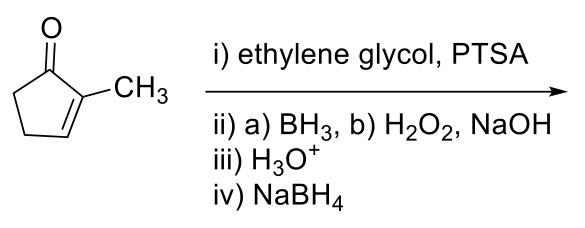
    2-Methylcyclopent-2-en-1-one, treated with: i) ethylene glycol, PTSA; ii) a) BHX3\ce{BH3}, b) HX2OX2\ce{H2O2}, NaOH; iii) HX3OX+\ce{H3O+}; iv) NaBHX4\ce{NaBH4}
    2-Methylcyclopent-2-en-1-one reacts with i) ethylene glycol, PTSA (above the arrow) and ii) a) BH₃, b) H₂O₂, NaOH; iii) H₃O⁺; iv) NaBH₄ (below the arrow).

List-II

  • 1
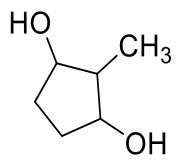
    2-Methylcyclopentane-1,3-diol: cyclopentane with OH on C1, CH₃ on C2 and OH on C3.
  • 2
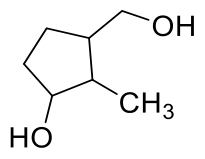
    3-(Hydroxymethyl)-2-methylcyclopentan-1-ol: cyclopentane with CH₂OH on one carbon, CH₃ on the next carbon and OH on the carbon after that.
  • 3
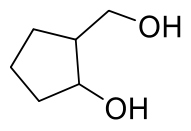
    2-(Hydroxymethyl)cyclopentan-1-ol: cyclopentane with CH₂OH on one carbon and OH on the adjacent carbon.
  • 4
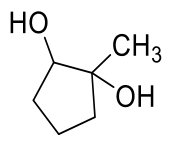
    1-Methylcyclopentane-1,2-diol: cyclopentane with CH₃ and OH on the same carbon and OH on the adjacent carbon.
  • 5
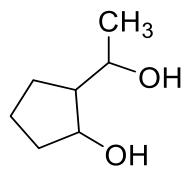
    2-(1-Hydroxyethyl)cyclopentan-1-ol: cyclopentane with a CH(OH)CH₃ group on one carbon and OH on the adjacent carbon.
Choose one option
Answer and worked solution

Official answer: A

Ethylene glycol/PTSA protects the carbonyl as an acetal or ketal so that the alkene can be hydrated first; HX3OX+\ce{H3O+} then removes the protection and NaBHX4\ce{NaBH4} reduces the carbonyl.

  • (P) Cyclohexene. Ozonolysis gives hexanedial; intramolecular aldol condensation gives cyclopent-1-ene-1-carbaldehyde. Protect the CHO; hydroboration puts OH on the neighbouring ring carbon (anti-Markovnikov); deprotect and reduce: 2-(hydroxymethyl)cyclopentan-1-ol → (3).
  • (Q) 1-Methylcyclohexene. Ozonolysis gives 6-oxoheptanal; aldol gives 1-acetylcyclopentene. Protect, hydroborate, deprotect, reduce: 2-(1-hydroxyethyl)cyclopentan-1-ol → (5).
  • (R) 2-Methylcyclopent-2-enone. Protect the ketone; oxymercuration-demercuration (Markovnikov) puts OH on the CH₃-bearing carbon; deprotect and reduce: 1-methylcyclopentane-1,2-diol → (4).
  • (S) Same substrate, hydroboration (anti-Markovnikov) puts OH on C3: 2-methylcyclopentane-1,3-diol → (1).

Option (A).