Skip to content
dronacharya.ai
← JEE Advanced 2023 · Paper 2
PhysicsNumerical+3Question 34 of 51

JEE Advanced 2023 · Paper 2, Physics question 17

Passage

PARAGRAPH II

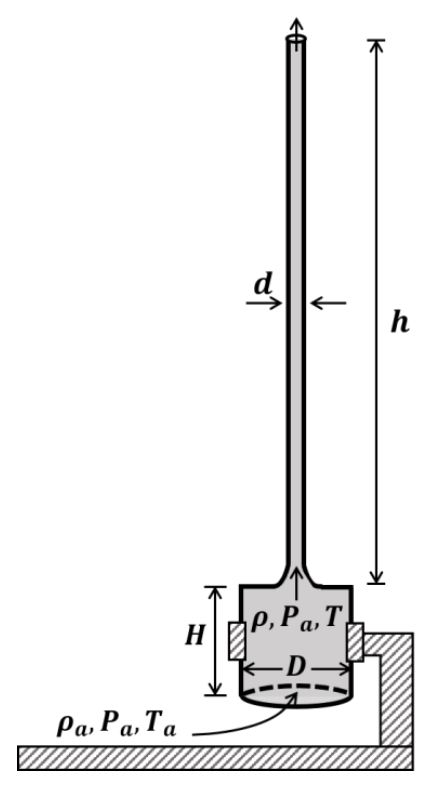
A cylindrical furnace has height (H)(H) and diameter (D)(D) both 1 m. It is maintained at temperature 360 K. The air gets heated inside the furnace at constant pressure PaP_a and its temperature becomes T=360 KT = 360\ K. The hot air with density ρ\rho rises up a vertical chimney of diameter d=0.1d = 0.1 m and height h=9h = 9 m above the furnace and exits the chimney (see the figure). As a result, atmospheric air of density ρa=1.2 kg m−3\rho_a = 1.2\ \mathrm{kg\,m^{-3}}, pressure PaP_a and temperature Ta=300T_a = 300 K enters the furnace. Assume air as an ideal gas, neglect the variations in ρ\rho and TT inside the chimney and the furnace. Also ignore the viscous effects.

[Given: The acceleration due to gravity g=10 m s−2g = 10\ \mathrm{m\,s^{-2}} and π=3.14\pi = 3.14]

A cylindrical furnace of height H and diameter D (containing air at rho, Pa, T) sits on the ground; outside air (rho_a, Pa, Ta) enters through its open base. A thin vertical chimney of diameter d and height h rises from the top of the furnace, with an arrow showing air exiting at the top.

When the chimney is closed using a cap at the top, a pressure difference ΔP\Delta P develops between the top and the bottom surfaces of the cap. If the changes in the temperature and density of the hot air, due to the stoppage of air flow, are negligible then the value of ΔP\Delta P is _____ N m−2\mathrm{N\,m^{-2}}.

Answer and worked solution

Official answer: Dropped: full marks to everyone

This question was dropped (marks to all) in the official key. Below is the standard hydrostatic working. The organisers did not publish a reason.

Densities.

  • Hot air: ρ=ρaTa/T=1.0\rho=\rho_a T_a/T=1.0 kg/m³.
  • Outside air: ρa=1.2\rho_a=1.2 kg/m³.

Pressures at the top. With the flow stopped, both columns are hydrostatic. Start from the same pressure PaP_a at the furnace inlet (ground level):

  • inside, just below the cap: Pa−ρg(H+h)P_a-\rho g(H+h);
  • outside, just above the cap: Pa−ρag(H+h)P_a-\rho_ag(H+h).

Difference.
ΔP=(ρa−ρ)g(H+h)=0.2×10×10=20 N/m2.\Delta P=(\rho_a-\rho)g(H+h)=0.2\times10\times10=20\ \text{N/m}^2.

Counting only the chimney height hh gives 18 N/m². This ambiguity in the set-up is one likely reason the question was dropped.