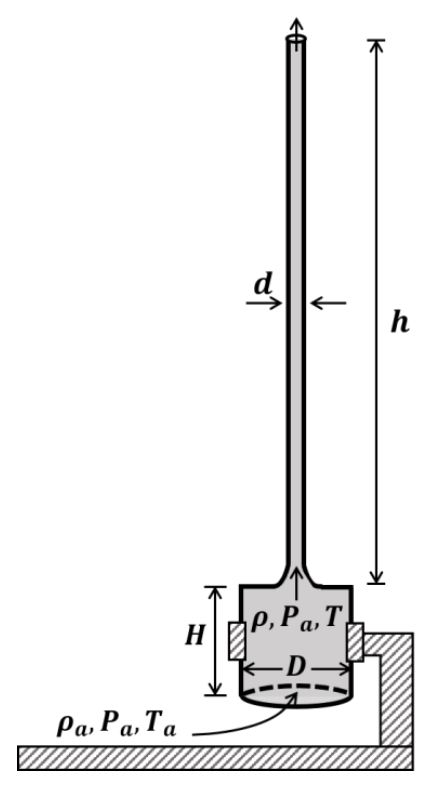
A cylindrical furnace has height (H) and diameter (D) both 1 m. It is maintained at temperature 360 K. The air gets heated inside the furnace at constant pressure Pa and its temperature becomes T=360K. The hot air with density ρ rises up a vertical chimney of diameter d=0.1 m and height h=9 m above the furnace and exits the chimney (see the figure). As a result, atmospheric air of density ρa=1.2kgm−3, pressure Pa and temperature Ta=300 K enters the furnace. Assume air as an ideal gas, neglect the variations in ρ and T inside the chimney and the furnace. Also ignore the viscous effects.
[Given: The acceleration due to gravity g=10ms−2 and π=3.14]
Considering the air flow to be streamline, the steady mass flow rate of air exiting the chimney is _____ gms−1.
Answer and worked solution
Official answer: Dropped: full marks to everyone
This question was dropped (marks to all) in the official key. Below is the standard idealised working, which gives about 49.6 g/s. The organisers did not publish why the question was dropped.
Density of hot air. At equal pressure, ρ=ρaTTa=1.2×360300=1.0kg/m3.
Exit speed. Apply Bernoulli along a streamline from the still air outside the furnace inlet to the chimney exit. The outside air column of height H+h supplies the pressure difference (ρa−ρ)g(H+h): v=ρ2(ρa−ρ)g(H+h)=1.02×0.2×10×10≈6.32m/s. The furnace cross-section is 100 times the chimney's, so the speed inside the furnace is negligible.
Mass flow rate. m˙=ρ4πd2v=1.0×3.14×0.0025×6.32≈0.0496kg/s≈49.6g/s.
Why the answer is not unique. It depends on modelling choices the paragraph leaves open:
whether the furnace height H counts in the driving column (using only h gives about 47 g/s);
how the inlet is treated.
This is a plausible reason no single answer could be keyed.