Skip to content
dronacharya.ai
← JEE Advanced 2023 · Paper 2
ChemistrySingle correct+3 / -1Question 37 of 51

JEE Advanced 2023 · Paper 2, Chemistry question 3

In the following reactions, P, Q, R, and S are the major products.

The correct statement about P, Q, R, and S is
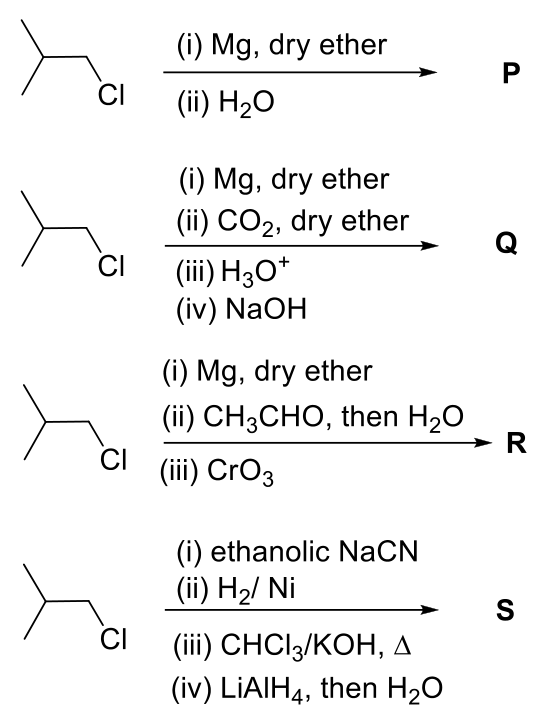
Four reactions of 1-chloro-2-methylpropane (isobutyl chloride): (1) [(i) Mg, dry ether; (ii) H2O] → P. (2) [(i) Mg, dry ether; (ii) CO2, dry ether; (iii) H3O+; (iv) NaOH] → Q. (3) [(i) Mg, dry ether; (ii) CH3CHO, then H2O; (iii) CrO3] → R. (4) [(i) ethanolic NaCN; (ii) H2/Ni; (iii) CHCl3/KOH, Δ; (iv) LiAlH4, then H2O] → S.
Choose one option
Answer and worked solution

Official answer: B

The substrate is isobutyl chloride, (CHX3)X2CHCHX2Cl\ce{(CH3)2CHCH2Cl} (call the (CHX3)X2CHCHX2X−\ce{(CH3)2CHCH2-} group R′).

P. The Grignard reagent is protonated by water to give isobutane, (CHX3)X2CHCHX3\ce{(CH3)2CHCH3}. This is an alkane, not an alcohol, so (A) is false.

Q. Carboxylation gives RX′COOH\ce{R'COOH} (3-methylbutanoic acid). NaOH turns it into the sodium salt Q. Kolbe electrolysis couples two R′ radicals:
2 RX′COOX−→RX′−RX′+2 COX2,\ce{2R'COO- -> R'-R' + 2CO2},
giving 2,5-dimethylhexane, CX8HX18\ce{C8H18}. (B) is true.

R.

  1. The Grignard reagent adds to acetaldehyde, giving (CHX3)X2CHCHX2CH(OH)CHX3\ce{(CH3)2CHCH2CH(OH)CH3}.
  2. CrOX3\ce{CrO3} oxidises it to 4-methylpentan-2-one (CX6\ce{C6}).

A ketone with α\alpha-H does not undergo the Cannizzaro reaction, so (C) is false.

S.

  1. RX′CN\ce{R'CN} is reduced to RX′CHX2NHX2\ce{R'CH2NH2}, a CX5\ce{C5} primary amine.
  2. The carbylamine reaction gives the isocyanide RX′CHX2NC\ce{R'CH2NC}.
  3. LiAlHX4\ce{LiAlH4} reduces the isocyanide to the secondary amine RX′CHX2NHCHX3\ce{R'CH2NHCH3} (CX6\ce{C6}).

(D) is false.