Skip to content
dronacharya.ai
← JEE Advanced 2022 · Paper 1
PhysicsList match+3 / -1Question 36 of 54

JEE Advanced 2022 · Paper 1, Physics question 18

List I contains four combinations of two lenses (1 and 2) whose focal lengths (in cm) are indicated in the figures. In all cases, the object is placed 20 cm from the first lens on the left, and the distance between the two lenses is 5 cm. List II contains the positions of the final images.

Which one of the following options is correct?
List-I

  • I
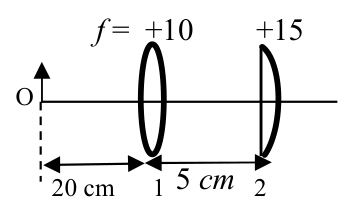
    Lens 1: f=+10f = +10 cm; lens 2: f=+15f = +15 cm (figure).
    Object O on the axis 20 cm left of lens 1; lenses 5 cm apart: convex f = +10 cm (lens 1), then convex f = +15 cm (lens 2).
  • II
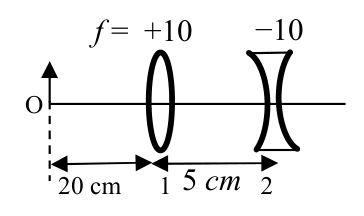
    Lens 1: f=+10f = +10 cm; lens 2: f=−10f = -10 cm (figure).
    Object O on the axis 20 cm left of lens 1; lenses 5 cm apart: convex f = +10 cm (lens 1), then concave f = −10 cm (lens 2).
  • III
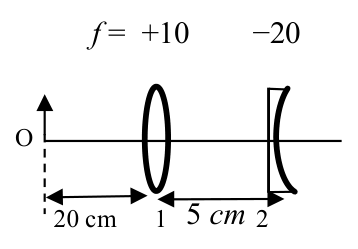
    Lens 1: f=+10f = +10 cm; lens 2: f=−20f = -20 cm (figure).
    Object O on the axis 20 cm left of lens 1; lenses 5 cm apart: convex f = +10 cm (lens 1), then plano-concave f = −20 cm (lens 2).
  • IV
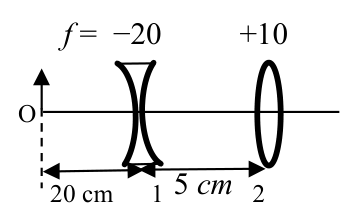
    Lens 1: f=−20f = -20 cm; lens 2: f=+10f = +10 cm (figure).
    Object O on the axis 20 cm left of lens 1; lenses 5 cm apart: concave f = −20 cm (lens 1), then convex f = +10 cm (lens 2).

List-II

  • P
    Final image is formed at 7.5 cm on the right side of lens 2.
  • Q
    Final image is formed at 60.0 cm on the right side of lens 2.
  • R
    Final image is formed at 30.0 cm on the left side of lens 2.
  • S
    Final image is formed at 6.0 cm on the right side of lens 2.
  • T
    Final image is formed at 30.0 cm on the right side of lens 2.
Choose one option
Answer and worked solution

Official answer: A

Use 1v−1u=1f\frac1v-\frac1u=\frac1f for each lens. The image of lens 1 is the object for lens 2, which is 5 cm away.

(I)

  • Lens 1: u=−20u=-20, f=10f=10, so v=20v=20.
  • Lens 2: object 15 cm beyond it (virtual), f=15f=15: 1v=115+115\frac1v=\frac1{15}+\frac1{15}, so v=7.5v=7.5 cm to the right → P.

(II)

  • Lens 2: f=−10f=-10, u=+15u=+15: 1v=−110+115\frac1v=-\frac1{10}+\frac1{15}, so v=−30v=-30, i.e. 30 cm to the left → R.

(III)

  • Lens 2: f=−20f=-20, u=+15u=+15: 1v=−120+115\frac1v=-\frac1{20}+\frac1{15}, so v=60v=60 cm to the right → Q.

(IV)

  • Lens 1: f=−20f=-20, u=−20u=-20, so v=−10v=-10.
  • Lens 2: object 15 cm to its left, f=10f=10: 1v=110−115\frac1v=\frac1{10}-\frac1{15}, so v=30v=30 cm to the right → T.