Skip to content
dronacharya.ai
← JEE Advanced 2022 · Paper 1
PhysicsList match+3 / -1Question 34 of 54

JEE Advanced 2022 · Paper 1, Physics question 16

List I describes four systems, each with two particles AA and BB in relative motion as shown in figures. List II gives possible magnitudes of their relative velocities (in m s−1\mathrm{m\,s^{-1}}) at time t=π3t = \dfrac\pi3 s.

Which one of the following options is correct?

List-I
  • I
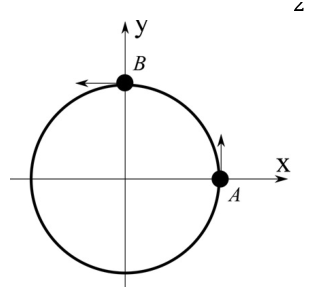
    AA and BB are moving on a horizontal circle of radius 1 m with uniform angular speed ω=1 rad s−1\omega = 1\ \mathrm{rad\,s^{-1}}. The initial angular positions of AA and BB at time t=0t = 0 are θ=0\theta = 0 and θ=π2\theta = \frac\pi2, respectively.
    A circle of radius 1 m centred at the origin with x and y axes. A is at (1, 0) with velocity arrow along +y; B is at (0, 1) with velocity arrow along −x (both moving anticlockwise).
  • II
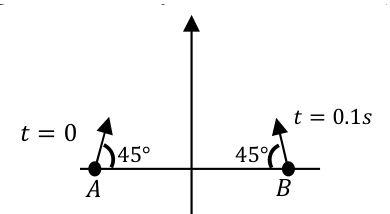
    Projectiles AA and BB are fired (in the same vertical plane) at t=0t = 0 and t=0.1t = 0.1 s respectively, with the same speed v=5π2 m s−1v = \frac{5\pi}{\sqrt2}\ \mathrm{m\,s^{-1}} and at 45∘45^\circ from the horizontal plane. The initial separation between AA and BB is large enough so that they do not collide. (g=10 m s−2g = 10\ \mathrm{m\,s^{-2}}).
    Two launch points on a horizontal line on either side of a vertical axis: A on the left fired at t = 0 at 45° towards the right, B on the right fired at t = 0.1 s at 45° towards the left (towards A).
  • III
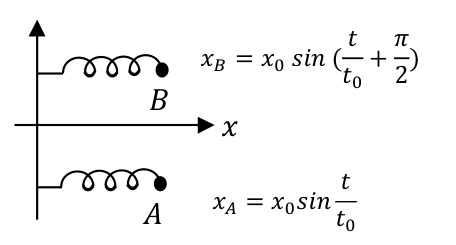
    Two harmonic oscillators AA and BB moving in the xx direction according to xA=x0sin⁡tt0x_A = x_0\sin\frac{t}{t_0} and xB=x0sin⁡(tt0+π2)x_B = x_0\sin\left(\frac{t}{t_0} + \frac\pi2\right) respectively, starting from t=0t = 0. Take x0=1x_0 = 1 m, t0=1t_0 = 1 s.
    Two spring-mass oscillators along x attached to a wall: B (upper) with x_B = x0 sin(t/t0 + π/2) and A (lower) with x_A = x0 sin(t/t0).
  • IV
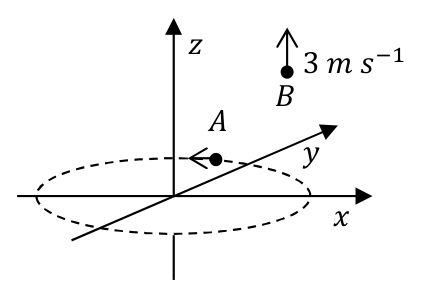
    Particle AA is rotating in a horizontal circular path of radius 1 m on the xyxy plane, with constant angular speed ω=1 rad s−1\omega = 1\ \mathrm{rad\,s^{-1}}. Particle BB is moving up at a constant speed 3 m s−13\ \mathrm{m\,s^{-1}} in the vertical direction as shown in the figure. (Ignore gravity.)
    A dashed horizontal circle in the xy-plane around the z-axis; particle A moves on it. Particle B above it moves straight up at 3 m/s.

List-II

  • P
    3+12\frac{\sqrt3+1}{2}
  • Q
    3−12\frac{\sqrt3-1}{\sqrt2}
  • R
    10\sqrt{10}
  • S
    2\sqrt2
  • T
    25π2+1\sqrt{25\pi^2+1}
Choose one option
Answer and worked solution

Official answer: C

(I) Both particles move at speed 1 m/s on the circle, a quarter-turn apart, so their velocities are always perpendicular:
∣v⃗rel∣=2 → S.|\vec v_{rel}|=\sqrt2\ \to\ \textbf{S}.

(II) A is fired to the right and B to the left, each at 45∘45^\circ with speed 5π2\frac{5\pi}{\sqrt2}, so each has horizontal speed 5π2\frac{5\pi}2.

  • Relative horizontal speed: 5π5\pi.
  • Relative vertical speed: B started 0.1 s later, so g×0.1=1g\times0.1=1 m/s.

At t=π3t=\frac\pi3 both are still in flight (A lands at π2\frac\pi2 s):
∣v⃗rel∣=25π2+1 → T.|\vec v_{rel}|=\sqrt{25\pi^2+1}\ \to\ \textbf{T}.

(III) vA=cos⁡tv_A=\cos t and vB=−sin⁡tv_B=-\sin t, so the relative speed is cos⁡t+sin⁡t=1+32\cos t+\sin t=\frac{1+\sqrt3}2 at π3\frac\pi3 → P.

(IV) A moves horizontally at 1 m/s and B vertically at 3 m/s:
∣v⃗rel∣=1+9=10 → R.|\vec v_{rel}|=\sqrt{1+9}=\sqrt{10}\ \to\ \textbf{R}.