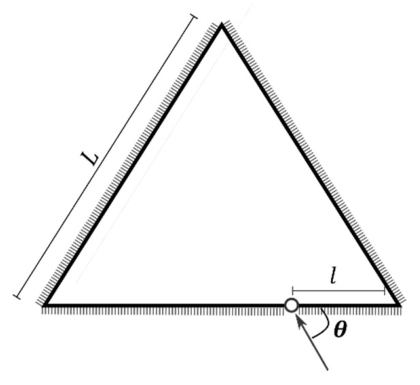
Put the base along the x-axis from the left corner (0,0) to the right corner (L,0). The hole is at (L−l,0), and the ray enters going up and to the left at angle θ to the base.
(A) True. For θ=30∘ the ray travels at 150∘ to the +x axis. The left mirror lies along 60∘, so the ray meets it at exactly 90∘. Moving left, the ray cannot reach the right mirror first. It is reflected straight back along its own path and leaves through the hole, for every 0<l<L.
(B) True. For l=2L and θ=60∘, the ray goes from the midpoint of the base to the midpoint of the left side, reflects to the midpoint of the right side, and reflects back to the hole. That is two reflections.
The θ=60∘ path in general.
- The ray runs parallel to the right side.
- It reflects off the left side and runs parallel to the base.
- It reflects off the right side and runs parallel to the left side, reaching the base at distance l from the left corner.
- After three more reflections (base, left, right) it returns to the hole.
That is five reflections in all (two when l=2L).
- (C) False: for l=3L the ray does come out.
- (D) False: it comes out after five reflections, not six.