Skip to content
dronacharya.ai
← JEE Advanced 2022 · Paper 1
ChemistryList match+3 / -1Question 51 of 54

JEE Advanced 2022 · Paper 1, Chemistry question 15

Match the rate expressions in LIST-I for the decomposition of X with the corresponding profiles provided in LIST-II. Xs\mathrm X_s and k are constants having appropriate units.

LIST-I

  • I
    rate=k[X]Xs+[X]\text{rate} = \dfrac{k[\mathrm X]}{\mathrm X_s + [\mathrm X]} under all possible initial concentrations of X
  • II
    rate=k[X]Xs+[X]\text{rate} = \dfrac{k[\mathrm X]}{\mathrm X_s + [\mathrm X]} where initial concentrations of X are much less than Xs\mathrm X_s
  • III
    rate=k[X]Xs+[X]\text{rate} = \dfrac{k[\mathrm X]}{\mathrm X_s + [\mathrm X]} where initial concentrations of X are much higher than Xs\mathrm X_s
  • IV
    rate=k[X]2Xs+[X]\text{rate} = \dfrac{k[\mathrm X]^2}{\mathrm X_s + [\mathrm X]} where initial concentration of X is much higher than Xs\mathrm X_s

LIST-II

  • P
    Plot of half-life against initial concentration: straight line with positive slope and intercept (figure).
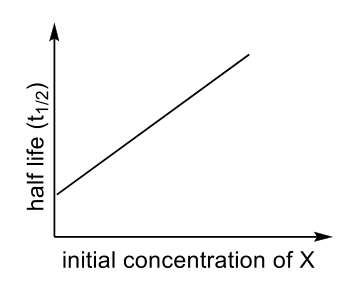
    Half-life t1/2 against initial concentration of X: a straight line rising with a positive intercept.
  • Q
    Plot of half-life against initial concentration: horizontal line (figure).
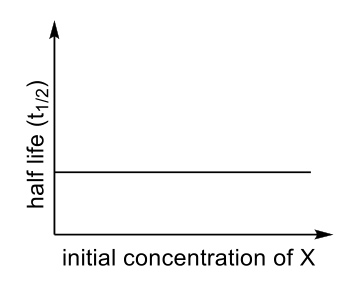
    Half-life t1/2 against initial concentration of X: a horizontal line (constant half-life).
  • R
    Plot of rate against initial concentration: rises and levels off (figure).
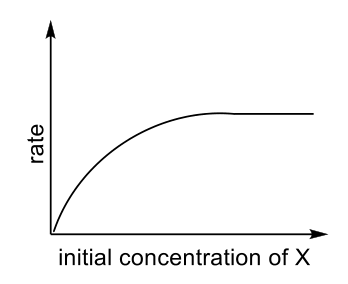
    Rate against initial concentration of X: rises from the origin and levels off to a plateau.
  • S
    Plot of [X] against time: straight falling line (figure).
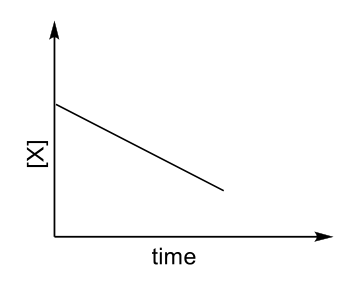
    [X] against time: a straight line falling with constant slope.
  • T
    Plot of ln[X] against time: straight falling line (figure).
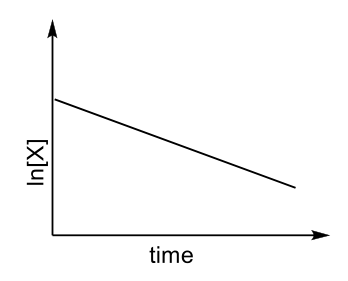
    ln[X] against time: a straight line falling with constant slope.
Choose one option
Answer and worked solution

Official answer: A

Let r=k[X]Xs+[X]r=\dfrac{k[\mathrm X]}{\mathrm X_s+[\mathrm X]}.

(I) The full rate law. Integrating −d[X]dt=r-\frac{d[\mathrm X]}{dt}=r gives
Xsln⁡[X]0[X]+([X]0−[X])=kt.\mathrm X_s\ln\frac{[\mathrm X]_0}{[\mathrm X]}+([\mathrm X]_0-[\mathrm X])=kt.
At half-life, kt1/2=Xsln⁡2+[X]02kt_{1/2}=\mathrm X_s\ln2+\frac{[\mathrm X]_0}2. This is linear in [X]0[\mathrm X]_0 with a positive intercept → P.

(II) [X]≪Xs[\mathrm X]\ll\mathrm X_s. The rate becomes kXs[X]\frac{k}{\mathrm X_s}[\mathrm X]: first order, constant half-life → Q.

(III) [X]≫Xs[\mathrm X]\gg\mathrm X_s. The rate becomes kk: zero order, so [X][\mathrm X] falls linearly with time → S.

(IV) k[X]2Xs+[X]\frac{k[\mathrm X]^2}{\mathrm X_s+[\mathrm X]} with [X]≫Xs[\mathrm X]\gg\mathrm X_s. The rate becomes k[X]k[\mathrm X]: first order, so ln⁡[X]\ln[\mathrm X] is linear in time → T.