Shown in the figure is a semicircular metallic strip that has thickness and resistivity . Its inner radius is and outer radius is . If a voltage is applied between its two ends, a current flows in it. In addition, it is observed that a transverse voltage develops between its inner and outer surfaces due to purely kinetic effects of moving electrons (ignore any role of the magnetic field due to the current). Then (figure is schematic and not drawn to scale)
← JEE Advanced 2020 · Paper 1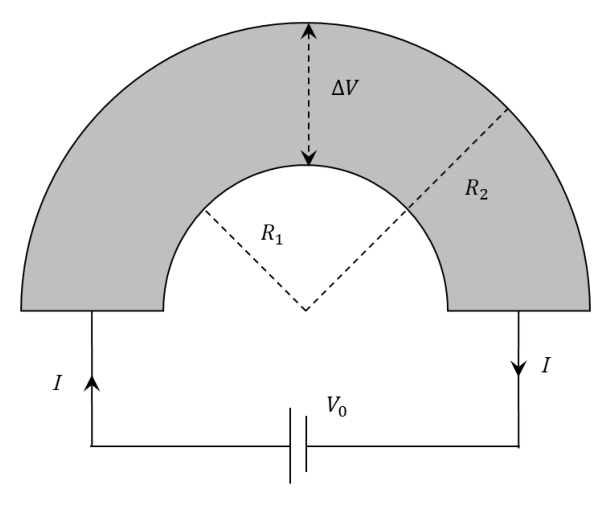
PhysicsMultiple correct+4 / -2Question 11 of 54
JEE Advanced 2020 · Paper 1, Physics question 11
Answer and worked solution
Official answer: A, C, D
(A) Current. Split the strip into semicircular paths of radius , width : each has length and cross-section , and all are in parallel between the ends.
(A) is true.
(B)/(C) Sign of . The electrons drift along circular arcs, so they need a force towards the centre. It comes from a radial electric field: must point inward, so points outward. The potential falls outward, so the outer surface is at the lower potential. (C) is true and (B) is false.
(D) The required field is and , so . (D) is true.
(A), (C), (D)