Skip to content
dronacharya.ai
← JEE Advanced 2019 · Paper 2
PhysicsList match+3 / -1Question 17 of 54

JEE Advanced 2019 · Paper 2, Physics question 17

Passage

Answer Q.17 and Q.18 by appropriately matching the lists based on the information given in the paragraph

In a thermodynamic process on an ideal monatomic gas, the infinitesimal heat absorbed by the gas is given by TΔXT\Delta X, where TT is temperature of the system and ΔX\Delta X is the infinitesimal change in a thermodynamic quantity XX of the system. For a mole of monatomic ideal gas X=32Rln⁡(TTA)+Rln⁡(VVA)X = \frac32R\ln\left(\frac T{T_A}\right) + R\ln\left(\frac V{V_A}\right). Here, RR is gas constant, VV is volume of gas, TAT_A and VAV_A are constants.

The List-I below gives some quantities involved in a process and List-II gives some possible values of these quantities.
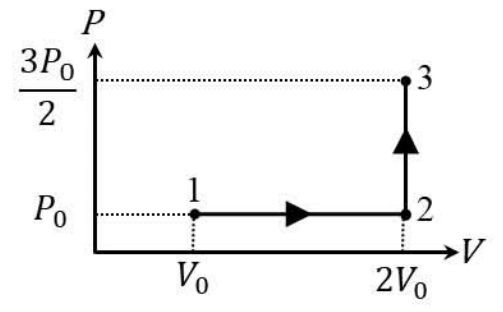
If the process carried out on one mole of monatomic ideal gas is as shown in figure in the PVPV-diagram with P0V0=13RT0P_0V_0 = \frac13RT_0, the correct match is,

P-V diagram: 1 (V₀, P₀) → 2 (2V₀, P₀) at constant pressure, then 2 → 3 (2V₀, 3P₀/2) at constant volume.

List-I

  • I
    Work done by the system in process 1→2→31\to2\to3
  • II
    Change in internal energy in process 1→2→31\to2\to3
  • III
    Heat absorbed by the system in process 1→2→31\to2\to3
  • IV
    Heat absorbed by the system in process 1→21\to2

List-II

  • P
    13RT0ln⁡2\frac13RT_0\ln2
  • Q
    13RT0\frac13RT_0
  • R
    RT0RT_0
  • S
    43RT0\frac43RT_0
  • T
    13RT0(3+ln⁡2)\frac13RT_0(3 + \ln2)
  • U
    56RT0\frac56RT_0
Choose one option
Answer and worked solution

Official answer: B

Here dQ=T dXdQ=T\,dX, so XX is the entropy. The answers need only the first law.

States, with T=PV/RT=PV/R and P0V0=13RT0P_0V_0=\frac13RT_0:

  • state 1: T1=T03T_1=\frac{T_0}3;
  • state 2: T2=2T03T_2=\frac{2T_0}3;
  • state 3: T3=T0T_3=T_0.

The quantities.

  • I. Work. Only the isobaric step 1→21\to2 does work: P0V0=13RT0P_0V_0=\frac13RT_0, (Q).
  • II. Change in internal energy. 32R(T0−T03)=RT0\frac32R\left(T_0-\frac{T_0}3\right)=RT_0, (R).
  • III. Heat over 1→2→31\to2\to3. Q=W+ΔU=43RT0Q=W+\Delta U=\frac43RT_0, (S).
  • IV. Heat in 1→21\to2. 52R⋅T03=56RT0\frac52R\cdot\frac{T_0}3=\frac56RT_0, (U).

(B)