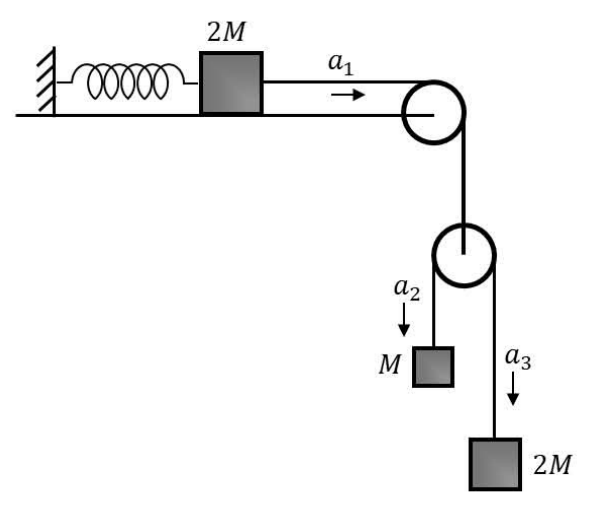
A block of mass 2M is attached to a massless spring with spring-constant k. This block is connected to two other blocks of masses M and 2M using two massless pulleys and strings. The accelerations of the blocks are a1, a2 and a3 as shown in the figure. The system is released from rest with the spring in its unstretched state. The maximum extension of the spring is x0. Which of the following option(s) is/are correct?
[g is the acceleration due to gravity. Neglect friction]
Answer and worked solution
Official answer: D
Constraint. The movable pulley moves down as fast as the table block moves right, and it is the average of the two hanging blocks: a1=2a2+a3⟹a2−a1=a1−a3. So (D) is true.
Dynamics. Let T be the tension in the lower string; the upper string carries 2T, and x is the spring's extension. 2Ma1=2T−kx,Ma2=Mg−T,2Ma3=2Mg−T. Eliminating T gives a1=74g−14M3kx. This is SHM with ω2=14M3k about the equilibrium extension xe=3k8Mg.
(A) The block starts from rest at x=0, so x0=2xe=3k16Mg, not k4Mg. False.
(B) At x0/2=xe the speed is the maximum, ωxe=14M3k⋅3k8Mg=8g42kM≈1.23gkM. The option gives 3g5kM≈1.34gkM. False.
(C) At x0/4 the displacement from equilibrium is xe/2, so ∣a1∣=ω22xe=14M3k⋅3k4Mg=72g, not 103g. False.