A rocket is moving in a gravity free space with a constant acceleration of along direction (see figure). The length of a chamber inside the rocket is 4 m. A ball is thrown from the left end of the chamber in direction with a speed of relative to the rocket. At the same time, another ball is thrown in direction with a speed of from its right end relative to the rocket. The time in seconds when the two balls hit each other is
← JEE Advanced 2014 · Paper 1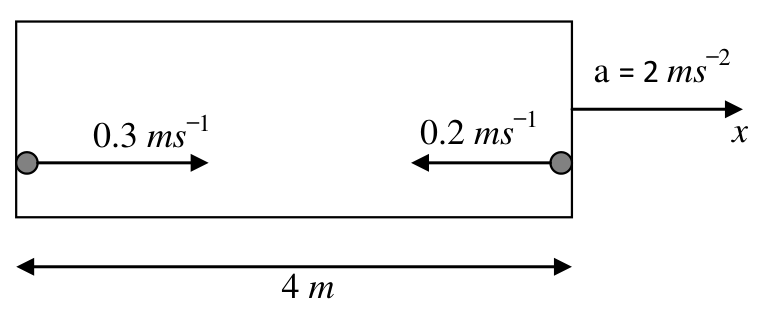
PhysicsInteger+3Question 18 of 60
JEE Advanced 2014 · Paper 1, Physics question 18
Answer and worked solution
Official answer: 2
In the rocket's frame both balls have the same acceleration, in the direction (pseudo-force). Their relative acceleration is zero.
Ignoring the walls. The relative speed is over 4 m:
Allowing for the left wall. The first ball's position is , which returns to the left wall at s. If it then stays at the wall, the second ball reaches it when , at s.
The question does not say what happens at the wall, so the official key accepts both readings.
Answer: 8 (key: 2 or 8)