Consider an elliptically shaped rail PQ in the vertical plane with OP = 3 m and OQ = 4 m. A block of mass 1 kg is pulled along the rail from P to Q with a force of 18 N, which is always parallel to line PQ (see the figure given). Assuming no frictional losses, the kinetic energy of the block when it reaches Q is Joules. The value of is (take acceleration due to gravity )
← JEE Advanced 2014 · Paper 1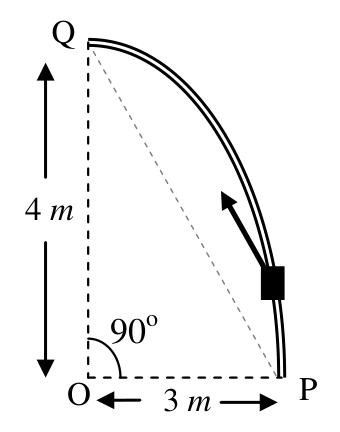
PhysicsInteger+3Question 17 of 60
JEE Advanced 2014 · Paper 1, Physics question 17
Answer and worked solution
Official answer: 5
Work by the pulling force. The force is constant (18 N along PQ), so its work depends only on the displacement , which has length m along the force:
Work by gravity. The block rises 4 m: J. The normal force does no work and there is no friction.
Kinetic energy at Q. Starting from rest, J J.
Answer: 5