A thin ring of mass 2 kg and radius 0.5 m is rolling without slipping on a horizontal plane with velocity 1 m/s. A small ball of mass 0.1 kg, moving with velocity 20 m/s in the opposite direction, hits the ring at a height of 0.75 m and goes vertically up with velocity 10 m/s. Immediately after the collision
← IIT-JEE 2011 · Paper 2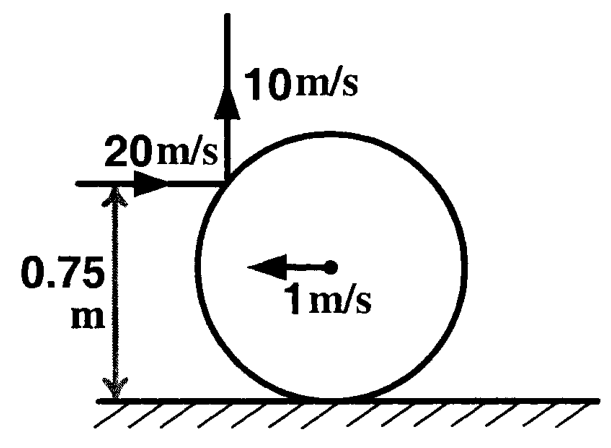
PhysicsMultiple correct+4Question 32 of 60
IIT-JEE 2011 · Paper 2, Physics question 32
Answer and worked solution
Official answer: A
Linear momentum (horizontal, collision impulse ≫ friction impulse). Taking right as positive: before, . After, the ball has no horizontal velocity, so the ring's centre is at rest.
Angular momentum about the centre. The ball hits at height 0.75 m, 0.25 m above the centre, at horizontal offset m. The ring receives impulse N s there, with angular impulse kg m² s⁻¹. Initially , so afterwards and the ring still spins (≈ 1.9 rad/s anticlockwise).
Result. Pure rotation about a stationary CM (A). The bottom point then slides to the right, so kinetic friction acts to the left (C). This is why the key accepts both A and AC.
(A) (key: A or AC)