Skip to content
dronacharya.ai
← IIT-JEE 2010 · Paper 1
PhysicsSingle correct+3 / -1Question 73 of 84

IIT-JEE 2010 · Paper 1, Physics question 73

Passage

Paragraph for Questions 73 to 74

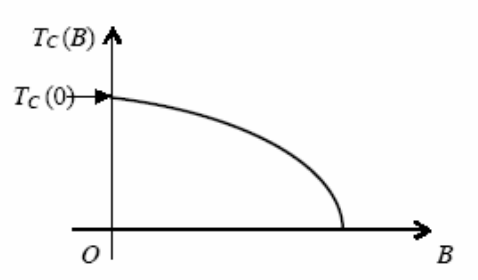
Electrical resistance of certain materials, known as superconductors, changes abruptly from a nonzero value to zero as their temperature is lowered below a critical temperature Tc(0)T_c(0). An interesting property of superconductors is that their critical temperature becomes smaller than Tc(0)T_c(0) if they are placed in a magnetic field, i.e., the critical temperature Tc(B)T_c(B) is a function of the magnetic field strength B. The dependence of Tc(B)T_c(B) on B is shown in the figure.

T_c(B) against B: starts at T_c(0) on the vertical axis and decreases, falling ever more steeply, to zero at a finite B.

In the graphs below, the resistance R of a superconductor is shown as a function of its temperature T for two different magnetic fields B1B_1 (solid line) and B2B_2 (dashed line). If B2B_2 is larger than B1B_1, which of the following graphs shows the correct variation of R with T in these fields?

Choose one option
Answer and worked solution

Official answer: A

Effect of the field. Tc(B)T_c(B) decreases with BB, so the larger field B2B_2 makes the resistance drop to zero at a lower temperature. Above the transition, in the normal state, the resistance follows the same curve in both fields.

That is graph (A): the dashed (B2B_2) curve becomes superconducting at a lower TT than the solid (B1B_1) curve.

(A)