Skip to content
dronacharya.ai
← IIT-JEE 2010 · Paper 1
PhysicsSingle correct+3 / -1Question 72 of 84

IIT-JEE 2010 · Paper 1, Physics question 72

Passage

Paragraph for Questions 70 to 72

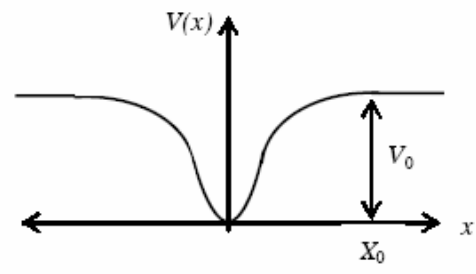
When a particle of mass m moves on the x-axis in a potential of the form V(x)=kx2V(x)=kx^2, it performs simple harmonic motion. The corresponding time period is proportional to mk\sqrt{\dfrac mk}, as can be seen easily using dimensional analysis. However, the motion of a particle can be periodic even when its potential energy increases on both sides of x=0x=0 in a way different from kx2kx^2 and its total energy is such that the particle does not escape to infinity. Consider a particle of mass m moving on the x-axis. Its potential energy is V(x)=αx4V(x)=\alpha x^4 (α>0\alpha>0) for ∣x∣|x| near the origin and becomes a constant equal to V0V_0 for ∣x∣≥X0|x|\ge X_0 (see figure).

V(x) against x: zero at the origin, rising smoothly on both sides (like αx⁴) and levelling off at the constant V₀ for |x| ≥ X₀.

The acceleration of this particle for ∣x∣>X0|x|>X_0 is

Choose one option
Answer and worked solution

Official answer: D

Force from the potential. F=−dVdxF=-\dfrac{dV}{dx}. For ∣x∣>X0|x|>X_0 the potential is the constant V0V_0, so F=0F=0 and the acceleration is zero.

(D)