Column II shows five systems in which two objects are labelled as X and Y. Also in each case a point P is shown. Column I gives some statements about X and/or Y. Match these statements to the appropriate system(s) from Column II.
← IIT-JEE 2009 · Paper 1
PhysicsMatrix match+8Question 60 of 60
IIT-JEE 2009 · Paper 1, Physics question 60
Column I
- AThe force exerted by X on Y has a magnitude .
- BThe gravitational potential energy of X is continuously increasing.
- CMechanical energy of the system X + Y is continuously decreasing.
- DThe torque of the weight of Y about point P is zero.
Column II
- PBlock Y of mass left on a fixed inclined plane X, slides on it with a constant velocity.
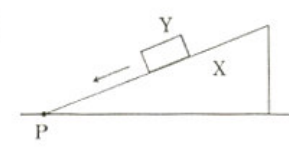
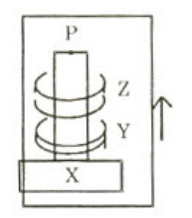
- QTwo ring magnets Y and Z, each of mass , are kept in frictionless vertical plastic stand so that they repel each other. Y rests on the base X and Z hangs in air in equilibrium. P is the topmost point of the stand on the common axis of the two rings. The whole system is in a lift that is going up with a constant velocity.
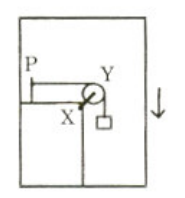
- RA pulley Y of mass is fixed to a table through a clamp X. A block of mass hangs from a string that goes over the pulley and is fixed at point P of the table. The whole system is kept in a lift that is going down with a constant velocity.
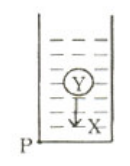
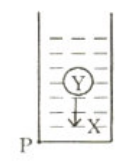
- SA sphere Y of mass is put in a nonviscous liquid X kept in a container at rest. The sphere is released and it moves down in the liquid.
- TA sphere Y of mass is falling with its terminal velocity in a viscous liquid X kept in a container.
| P | Q | R | S | T | |
|---|---|---|---|---|---|
| A | |||||
| B | |||||
| C | |||||
| D |
Answer and worked solution
Official answer: A → P, T; B → Q, S, T; C → P, R, T; D → Q
- A, force of X on Y equals Mg: when Y moves with constant velocity the net force on it is zero, so the total force from X balances its weight: P (incline: normal plus friction) and T (buoyancy plus viscous drag). In Q the base pushes Y with 2Mg; in S the sphere accelerates.
- B, potential energy of X increasing: in Q the lift carries the base upward; in S and T the sinking sphere displaces liquid upward. → Q, S, T.
- C, mechanical energy of X + Y decreasing: friction in P and viscosity in T dissipate energy; in R the system descends at constant speed, losing potential energy with no gain in kinetic energy. → P, R, T.
- D, torque of Y's weight about P is zero: only in Q does P lie on the vertical line through Y (the common axis of the rings). → Q.
Answer: A → P, T; B → Q, S, T; C → P, R, T; D → Q