Six point charges, each of the same magnitude , are arranged in different manners as shown in Column II. In each case, a point M and a line PQ passing through M are shown. Let be the electric field and be the electric potential at M (potential at infinity is zero) due to the given charge distribution when it is at rest. Now, the whole system is set into rotation with a constant angular velocity about the line PQ. Let be the magnetic field at M and be the magnetic moment of the system in this condition. Assume each rotating charge to be equivalent to a steady current.
← IIT-JEE 2009 · Paper 1
PhysicsMatrix match+8Question 59 of 60
IIT-JEE 2009 · Paper 1, Physics question 59
Column I
- A
- B
- C
- D
Column II
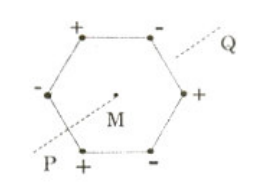
- PCharges are at the corners of a regular hexagon. M is at the centre of the hexagon. PQ is perpendicular to the plane of the hexagon.
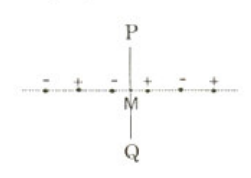
- QCharges are on a line perpendicular to PQ at equal intervals. M is the mid-point between the two innermost charges.
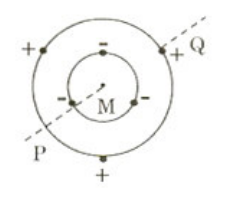
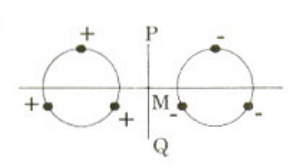
- RCharges are placed on two coplanar insulating rings at equal intervals. M is the common centre of the rings. PQ is perpendicular to the plane of the rings.
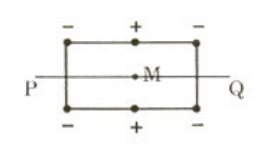
- SCharges are placed at the corners of a rectangle of sides and and at the mid points of the longer sides. M is at the centre of the rectangle. PQ is parallel to the longer sides.
- TCharges are placed on two coplanar, identical insulating rings at equal intervals. M is the mid-point between the centres of the rings. PQ is perpendicular to the line joining the centres and coplanar to the rings.
| P | Q | R | S | T | |
|---|---|---|---|---|---|
| A | |||||
| B | |||||
| C | |||||
| D |
Answer and worked solution
Official answer: A → P, R, S; B → R, S; C → P, Q, T; D → R, S
- P (alternating charges on a hexagon): opposite corners carry opposite charges, so each pair's field points towards its negative charge; the three such fields are 120° apart and cancel: . The net charge is zero at equal distances: . Rotating, the net charge on the single ring is zero, so and .
- Q (alternating charges on a line): the innermost pair gives a nonzero field at M. Each charge has an opposite charge at the same distance on the other side: , and on rotation each circle carries zero net charge: , .
- R (three − on the inner ring, three + on the outer ring): each ring's field cancels at the centre: . . Rotation gives opposite currents in rings of different radii, so neither nor cancels.
- S (− at the corners, + at the long-side midpoints): symmetric pairs cancel: ; but . All charges are at distance from PQ, with net charge , so rotation gives nonzero and .
- T (+ ring and − ring, mirror images): the field at M is nonzero (both rings push/pull the same way). Each + charge has a − charge at the mirror point, at the same distance from M and from PQ, so , and their circular currents cancel exactly: , .
Answer: A → P, R, S; B → R, S; C → P, Q, T; D → R, S