Two wires each carrying a steady current are shown in four configurations in Column I. Some of the resulting effects are described in Column II. Match the statements in Column I with the statements in Column II and indicate your answer by darkening appropriate bubbles in the 4 × 4 matrix given in the ORS.
← IIT-JEE 2007 · Paper 2
PhysicsMatrix match+6Question 21 of 66
IIT-JEE 2007 · Paper 2, Physics question 21
Column I
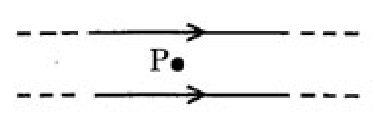
- APoint P is situated midway between the wires.
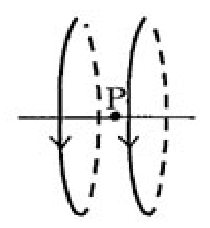
- BPoint P is situated at the mid-point of the line joining the centers of the circular wires, which have same radii.
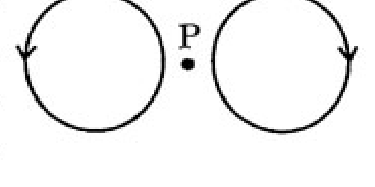
- CPoint P is situated at the mid-point of the line joining the centers of the circular wires, which have same radii.
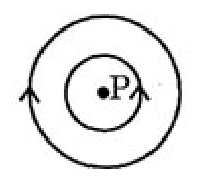
- DPoint P is situated at the common center of the wires.
Column II
- PThe magnetic fields () at P due to the currents in the wires are in the same direction.
- QThe magnetic fields () at P due to the currents in the wires are in opposite directions.
- RThere is no magnetic field at P.
- SThe wires repel each other.
| P | Q | R | S | |
|---|---|---|---|---|
| A | ||||
| B | ||||
| C | ||||
| D |
Answer and worked solution
Official answer: A → Q, R; B → P; C → Q, R; D → Q
- A: Parallel wires with currents in the same direction: at the midpoint their fields are equal and opposite, so they cancel. → Q, R. (Like currents attract, so not S.)
- B: Coaxial loops with currents in the same sense: on the axis both fields point the same way. → P. (They attract.)
- C: At P the left loop (anticlockwise) gives a field into the page and the right loop (clockwise) a field out of it, equal in size by symmetry: they cancel. → Q, R.
- D: Concentric loops with opposite currents: their fields at the centre are opposite but unequal (different radii), so B ≠ 0. → Q. Opposite currents repel, so the key also accepts Q, S.
Answer: A → Q, R; B → P; C → Q, R; D → Q