Skip to content
dronacharya.ai
← IIT-JEE 2007 · Paper 1
PhysicsSingle correct+4 / -1Question 19 of 66

IIT-JEE 2007 · Paper 1, Physics question 19

Passage

Paragraph for Question Nos. 17 to 19

A fixed thermally conducting cylinder has a radius RR and height L0L_0. The cylinder is open at its bottom and has a small hole at its top. A piston of mass MM is held at a distance LL from the top surface, as shown in the figure. The atmospheric pressure is P0P_0.

(Figure: a vertical cylinder of radius R, closed at the top except for a small hole, open at the bottom; a piston of mass M inside at distance L below the top.)

(The paragraph is not printed in the official archive copy (which reproduces only the questions with their answers); its text is restored from the JEE 2007 question paper.)
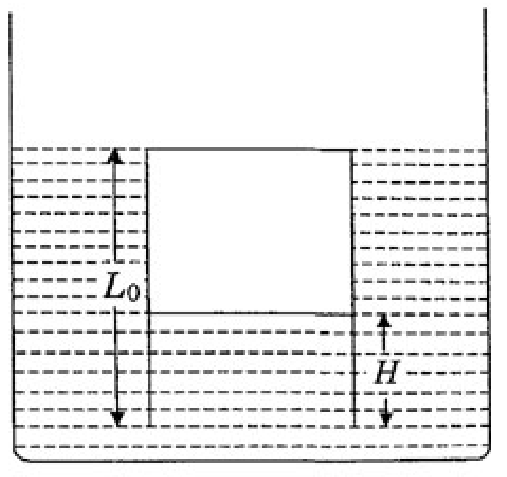
The piston is taken completely out of the cylinder. The hole at the top is sealed. A water tank is brought below the cylinder and put in a position so that the water surface in the tank is at the same level as the top of the cylinder as shown in the figure. The density of the water is ρ\rho. In equilibrium, the height HH of the water column in the cylinder satisfies

A water tank with an inverted cylinder of height L₀ fully submerged, its closed top level with the water surface; water has risen inside the cylinder to height H above its open bottom, trapping air above.
Choose one option
Answer and worked solution

Official answer: C

Trapped air. Air at P0P_0 fills length L0L_0 when sealed. After the tank is raised, water enters to height HH, leaving an air column L0−HL_0-H whose lower end is at depth L0−HL_0-H below the outside water surface:
P=P0+ρg(L0−H).P=P_0+\rho g(L_0-H).

Boyle's law. P0L0=[P0+ρg(L0−H)](L0−H)P_0L_0=\left[P_0+\rho g(L_0-H)\right](L_0-H), i.e.
ρg(L0−H)2+P0(L0−H)−L0P0=0.\rho g(L_0-H)^2+P_0(L_0-H)-L_0P_0=0.

(C)