Skip to content
dronacharya.ai
KVPY 2021PhysicsSingle correct+2 / -0.5

Physics, question 70

From KVPY 2021 · Stream SA

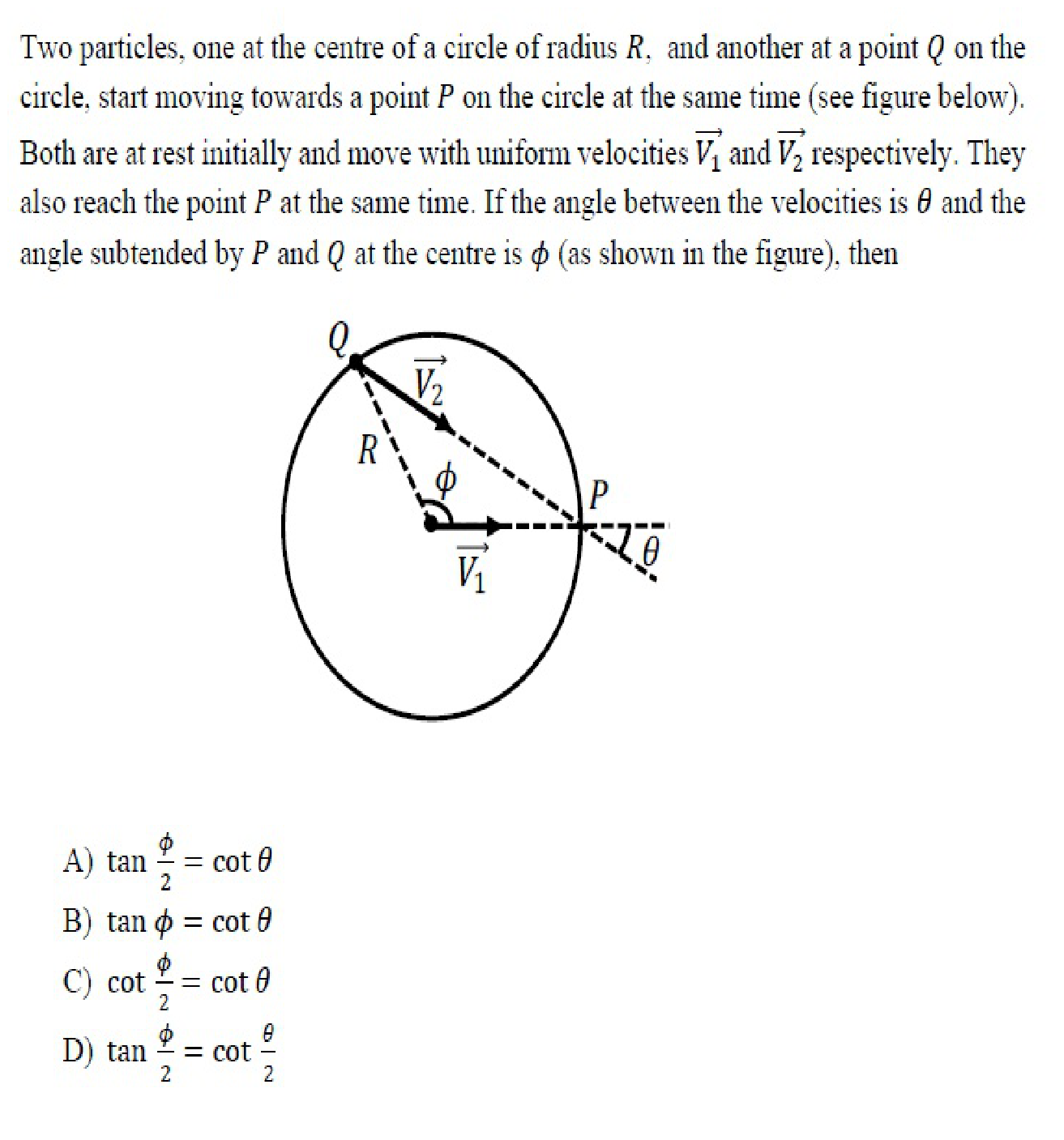
Two particles, one at the centre of a circle of radius RR, and another at a point QQ on the circle, start moving towards a point PP on the circle at the same time (see figure below). Both are at rest initially and move with uniform velocities V1⃗\vec{V_1} and V2⃗\vec{V_2} respectively. They also reach the point PP at the same time. If the angle between the velocities is θ\theta and the angle subtended by PP and QQ at the centre is ϕ\phi (as shown in the figure), then

A circle of radius R: one particle at the centre moves with V1 towards P on the circle; another at Q on the circle moves with V2 along the chord QP; φ is the angle QOP at the centre and θ the angle between the two velocity directions at P.
Choose one option
Answer and worked solutionTry it first, then open this to check your working.
Official answerA

Worked solution

The particles move along OPOP and QPQP and meet at PP, so the angle between their velocities is the angle ∠OPQ\angle OPQ of triangle OPQOPQ.

OP=OQ=ROP = OQ = R, so the triangle is isosceles, and
θ=∠OPQ=180∘−ϕ2=90∘−ϕ2.\theta = \angle OPQ = \frac{180^\circ - \phi}{2} = 90^\circ - \frac\phi2.
Hence tan⁡ϕ2=cot⁡θ\tan\frac\phi2 = \cot\theta.

(A)

Practise this topic

Every past question tagged to the same part of the syllabus, with solutions.

full papers
153
questions
13,073
worked solutions
13,054

Sit a paper tonight. See exactly where you stand.

Timed, in the real format, and marked the moment you submit.