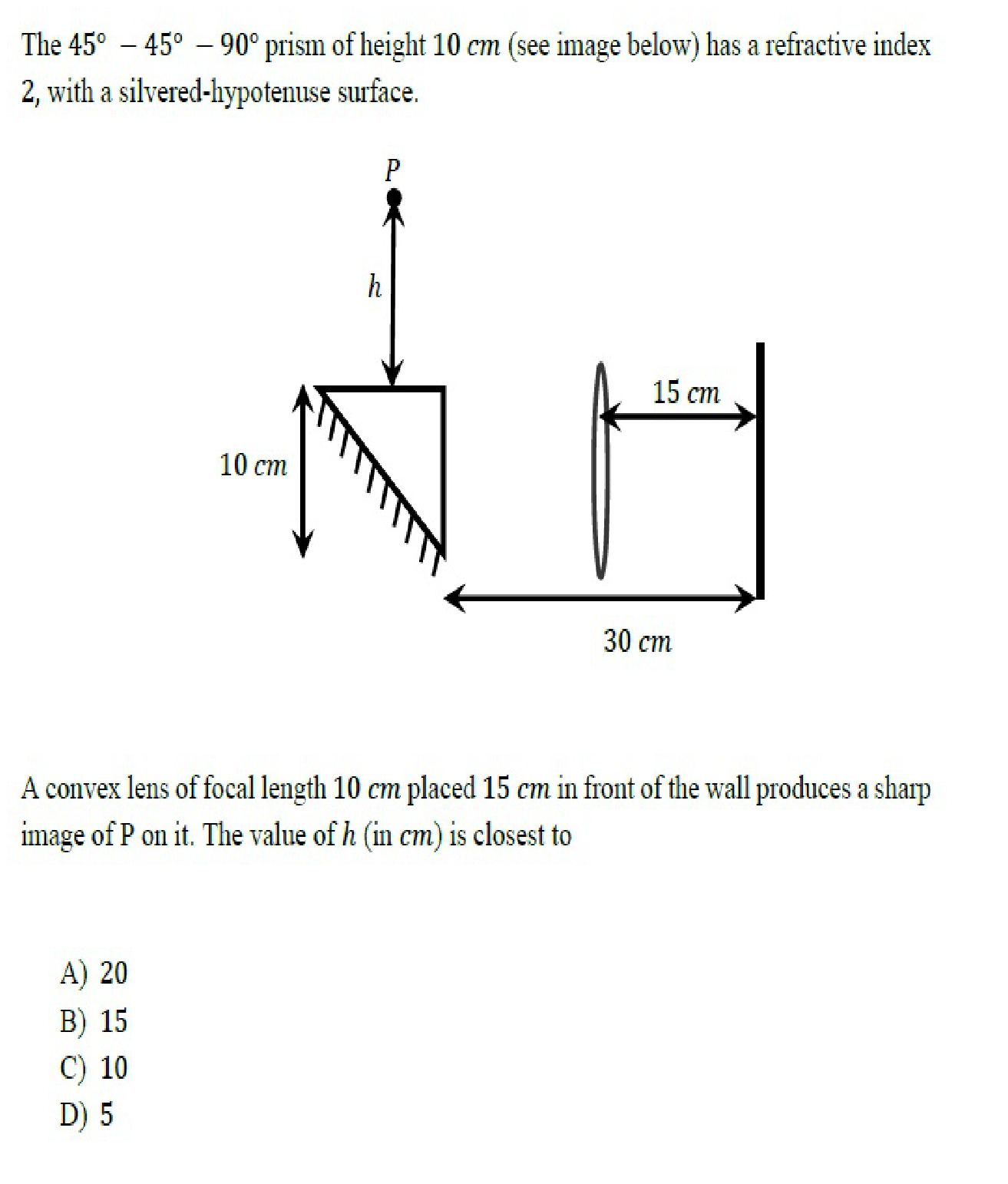
The prism of height 10 cm (see image below) has a refractive index 2, with a silvered-hypotenuse surface.
A convex lens of focal length 10 cm placed 15 cm in front of the wall produces a sharp image of P on it. The value of (in cm) is closest to
From KVPY 2021 · Stream SA
The prism of height 10 cm (see image below) has a refractive index 2, with a silvered-hypotenuse surface.
A convex lens of focal length 10 cm placed 15 cm in front of the wall produces a sharp image of P on it. The value of (in cm) is closest to
Worked solution
The lens forms its image on the wall, so cm and
So the object seen by the lens must be 30 cm from the lens, i.e. 15 cm beyond the prism's right face (the lens is 15 cm from that face).
Inside the prism, a ray goes down from the top face to the silvered hypotenuse and then across to the right face. Because the hypotenuse is at , this path is always 10 cm long. At refractive index 2, 10 cm of glass is equivalent to cm of air. So appears at from the right face:
(C)
Every past question tagged to the same part of the syllabus, with solutions.
Timed, in the real format, and marked the moment you submit.