Skip to content
dronacharya.ai
KVPY 2020PhysicsSingle correct+1 / -0.25

Physics, question 32

From KVPY 2020 · Streams SB/SX

A right-angled isosceles prism is held on the surface of a liquid composed of miscible solvents A and B of refractive index nA=1.50n_A = 1.50 and nB=1.30n_B = 1.30, respectively. The refractive index of prism is np=1.5n_p = 1.5 and that of the liquid is given by nL=CAnA+(1−CA)nBn_L = C_An_A+(1-C_A)n_B, where CAC_A is the percentage of solvent A in the liquid.
If θc\theta_c is the critical angle at prism-liquid interface, the plot which best represents the variation of the critical angle with the percentage of solvent is:
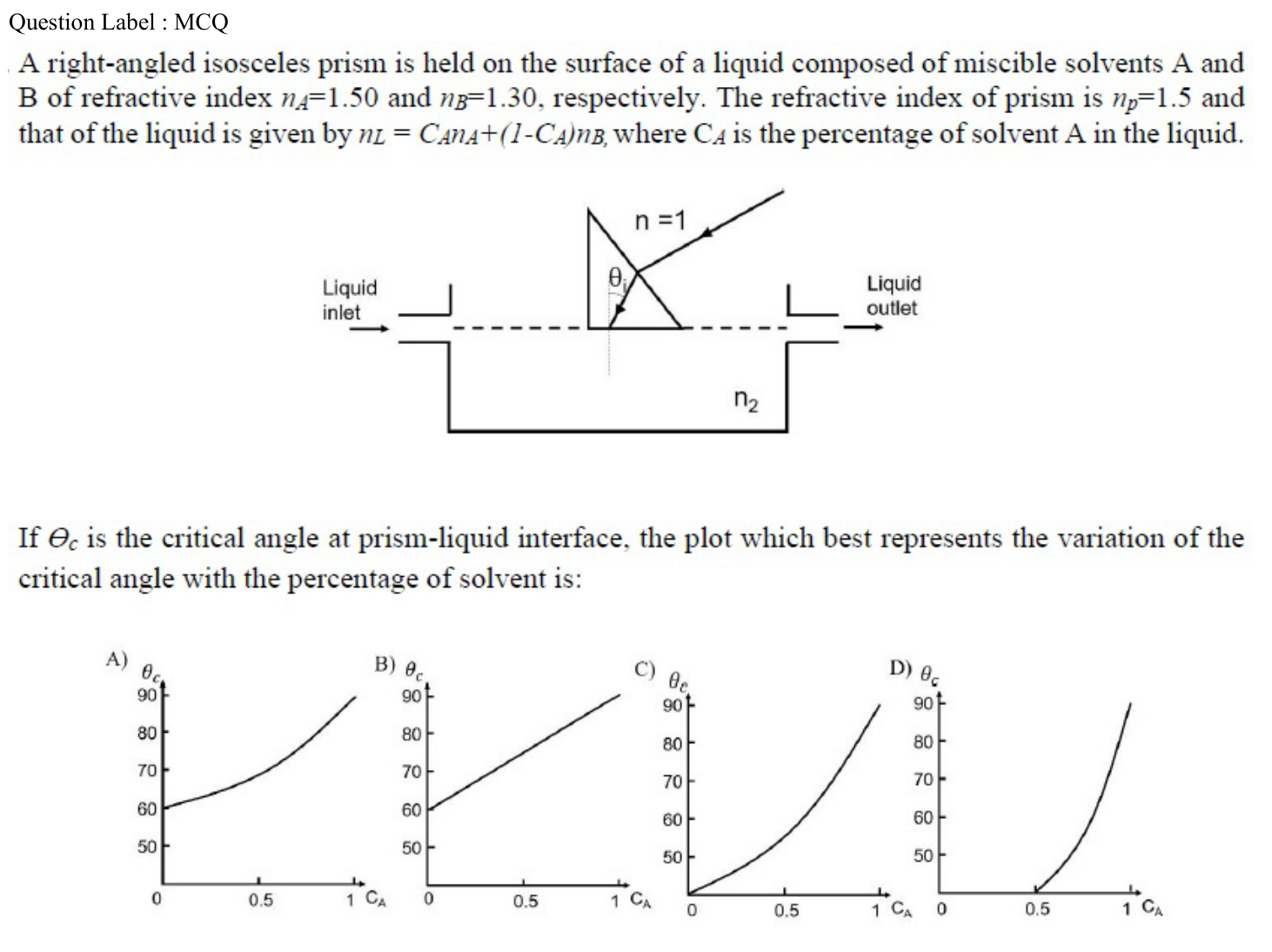
A right-angled isosceles prism resting on the surface of a liquid (index n2) in a flow cell with liquid inlet and outlet; a ray enters the prism from air and meets the prism-liquid face at angle θ. Below, four plots (A)-(D) of θc against C_A from 0 to 1, as described in the options.
Choose one option
Answer and worked solutionTry it first, then open this to check your working.
Official answerA

Worked solution

sin⁡θc=nLnp=1.30+0.20CA1.5\sin\theta_c = \dfrac{n_L}{n_p} = \dfrac{1.30+0.20C_A}{1.5}. At CA=0C_A = 0, sin⁡θc=0.867\sin\theta_c = 0.867, so θc≈60°\theta_c \approx 60°; at CA=1C_A = 1, sin⁡θc=1\sin\theta_c = 1 and θc=90°\theta_c = 90°. Since θc=sin⁡−1(⋅)\theta_c = \sin^{-1}(\cdot) of a linear function, it rises ever more steeply (concave up) towards 90°: plot A.

(A)

Practise this topic

Every past question tagged to the same part of the syllabus, with solutions.

full papers
153
questions
13,073
worked solutions
13,054

Sit a paper tonight. See exactly where you stand.

Timed, in the real format, and marked the moment you submit.